

Does ChatGPT Know How to Do SEO?
“Can ChatGPT Do SEO?” ChatGPT can do parts of the SEO process, but it can’t do the entire process.
ChatGPT can be very helpful for qualifying keywords, creating a cohesive plan from an existing pool of options, suggesting keyword ideas and topics, and creating outlines and rough drafts for content.
In fact, if you ask ChatGPT itself if it can do SEO, it will likely admit that it can only help in certain areas.
Here’s what my Chat said:
“Short answer: yes—but not by itself. ChatGPT is a very strong SEO assistant, not a full SEO engine. If you use it properly, it can dramatically speed up strategy, content, and execution.If you rely on it blindly, it can quietlyhurt your results.”
Its answer cracked me up because it contained three of the main issues with using ChatGPT for content creation: AI filler words like “quietly”, em dash overuse, and reliance on lists of three.
Article by Colette Nichol, Story Strategist and Organic Growth Specialist
As a content creator and SEO strategist, I use ChatGPT for 1-2 hours per day. In the trenches with ChatGPT, I’ve seen both its benefits and limitations as an SEO tool.
I’ve also been doing SEO since 2016 — long before Chat came along and disrupted the industry.
The hard truth is that if you don’t know anything about SEO, ChatGPT will likely send you down some wild and unprofitable paths in its attempt to help you rank your website. Moreover, it can’t do every single part of the process. It can’t fix your website UX issues, generate expert insight, or inject humanity into your content.
If you want to do SEO and get results, you will have to employ some skilled humans.
But let’s break down EXACTLY how ChatGPT can help you do SEO better and faster, and where it falls flat or simply cannot perform.
*Style note: I am using Chat and ChatGPT interchangeably in this post.
Table of Contents
- How Can You Use ChatGPT for SEO?
- Here’s What ChatGPT Does NOT Do
- What Are the Pros and Cons of AI-Generated SEO Content?
- Is Human Oversight Required for AI Content?
- Summary of Key Points
- To Bot, Or Not to Bot
- FAQ
START Driving Traffic to Your Website: Speak with an SEO Consultant →
How Can You Use ChatGPT for SEO?
The easiest way for me to answer this question will be to create a long list of all the things ChatGPT can help you do when creating your SEO workflow.
But first, some context may be helpful. ChatGPT needs a lot of context to do anything properly. In addition, the prompt that you use and the biases you have injected into your Chat will affect its output.
I’ve had clients come to me super worried about Generative Engine Optimization (GEO), which is the process of optimizing your website content and off-page presence to gain visibility on AI Agents like ChatGPT.
How did the client get obsessed with this small marketing channel? Through conversations with Chat, of course. But, as of this writing, AI Agents are not big traffic or revenue drivers for most businesses, so getting obsessed with your visibility on Copilot or even ChatGPT is not a good idea unless you’re a tech company.
Yet, my client was deeply concerned that his business would be invisible if he didn’t show up on ChatGPT frequently.
He also, incorrectly, believed that he could double his booked calls by focusing on this one small channel.
So, while I’m going to share ways you can use ChatGPT, I will warn you that I’ve seen it produce guidance and tips that are not true reflections of reality.
If you’re working on a high-stakes project and you don’t have time to get bad instructions from a pattern machine, you should be working with an expert.
Now, here are all the main things you can use ChatGPT for when creating an SEO campaign:
Strategy & Planning
Using Chat for strategy is risky because you have to ensure you include enough information for it to generate good ideas.
However, if you give it enough context, it can be a good starting point. It can help you do the following:
- Help clarify your target audience and their search intent
- Turn your services into content ideas
- Suggest a basic content strategy (pillar + supporting pages)
- Identify obvious content gaps if you tell it every piece of content
Early-Stage Keyword Research
Using ChatGPT for early-stage research can be helpful if you’re trying to get more ideas for a particular niche.
However, there is a big limitation here: Chat does not have access to real search volume numbers or competitor research. You actually need to use a tool like Ahrefs or SEMRush to do your full keyword research.
Chat is just a starting point to get the juices flowing. It can help you do the following:
- Generate keyword ideas from a seed topic
- Suggest related searches and questions
- Group keywords into rough clusters based on intent
Structuring Content & Creating Outlines
Chat often does not have the latest information about what helps content to rank, and it can sometimes create very odd outlines. Thus, you should begin with a template.
Here’s how Chat can help:
- Create outlines for blog posts and service pages
- Suggest headings (H1, H2, H3) based on topic coverage
- Recommend sections to include based on search intent
Content Writing Support
If you’re in a high-trust industry like financial services, you cannot just write content with ChatGPT and release it to the world.
It has to be reviewed, humanized, and ideally supplemented with expert insights.
One effective way to use Chat for content creation is to interview an expert based on a content outline and then get Chat to use your transcript to pull on the expert’s unique insights to create the content piece. From there, you can refine and punch up the content. For a highly competitive or high-trust niche, AI-only content won’t win.
Chat can help you with the following:
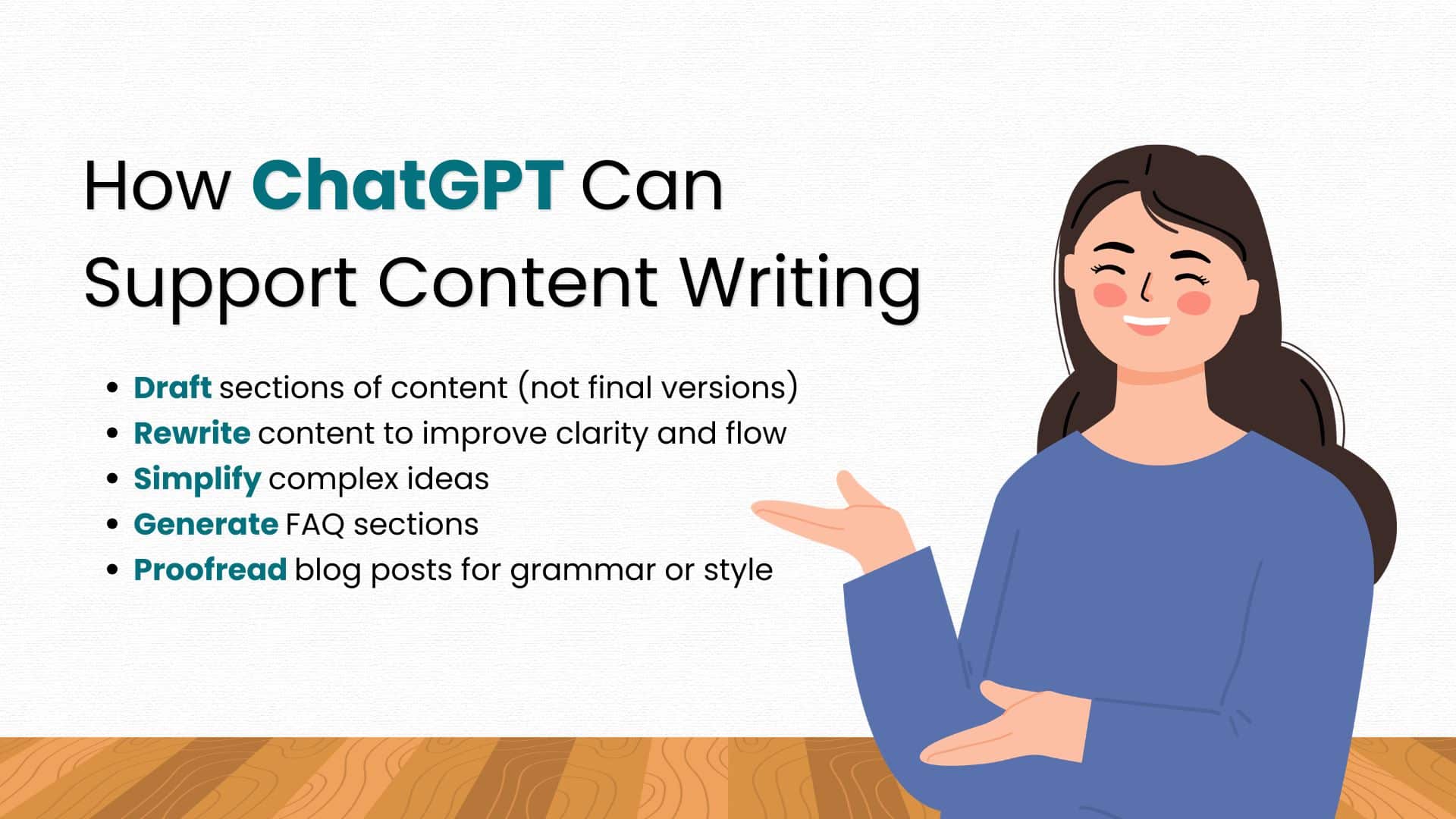
- Draft sections of content (not final versions)
- Rewrite content to improve clarity and flow
- Simplify complex ideas
- Generate FAQ sections
- Proofread blog posts for grammar or style
Chat works best when editing or expanding, not writing from scratch. It also works well if given raw inputs and a structured framework and tasked with turning that into content.
However, I have had a client whose largely AI-written project has been successful.
The client has written all the blog posts using ChatGPT and highly specific prompts. However, we’ve provided the in-depth outlines.
I’ve also written most of the introductions for his blog posts, as well as the pivot text that moves readers into action. In other words, his intros are written by a human SEO expert. And the remaining content is written by AI and then fact-checked by an expert. In other words, we’re running a hybrid model for his project, and it’s working.
Side note: the intro is often the most important part of a blog for both SEO and hooking readers, so having it written by a good copywriter who understands SEO is often wise.
On-Page SEO (Manual Input Required)
On-page SEO refers to all the things you do on a website to improve its ability to rank.
This ranges from fixing broken links to improving SEO site titles to interlinking blog posts and rewriting your homepage. Chat cannot do the fixes for you, but it can provide some of the text that will help you update the site. Again, you have to give it excellent context. But if you do, Chat can help you:
- Write title tags
- Write meta descriptions
- Suggest internal linking ideas
- Improve keyword usage and readability
Keep in mind that Chat cannot see every aspect of your website. You have to paste content in and use solid prompts to get a good output.
Basic Technical SEO Assistance
Technical SEO refers to anything “technical” you do on your website to improve search visibility.
It can range from speeding up load times to fixing major UX issues. Chat cannot go onto your website and fuss around with your UX or improve your website. But it can help you solve technical issues.
Here are some things you can use Chat for:
- Generate schema markup (JSON-LD)
- Create examples of meta tags
- Explain technical concepts (robots.txt, canonicals, indexing)
- Help troubleshoot issues conceptually
Keep in mind that Chat cannot implement or verify anything on your site. You can use tools like Screaming Frog and Ahrefs to assess any site health issues.
Content Optimization
ChatGPT can sometimes be used to improve content.
That said, it can also make a content creator go insane. If you do not have solid prompts to help the AI help you, then this is a recipe for disaster. It also has a tendency to contradict itself within the same conversation.
It may recommend removing a topic. A few prompts later, it may recommend adding that same topic back. So you have to be very careful and strict with your prompting if you want Chat to help you optimize your content.
Here’s how ChatGTP can help:
- Suggest improvements to existing content if given strict guidance
- Identify missing sections or weak explanations
- Identify opportunities for tables or structured data
- Expand thin content
- Fact-check old blog posts
- Identify areas where expert insights or case studies would be useful
- Write the SEO title tag and meta description based on the keyword
Internal Linking Assistance
Internal linking refers to strategically linking from one piece of your content to another piece of your content. In other words, you are linking within your own website.
You can see internal linking on great display if you go to Wikipedia, where every article links to many other articles.
While I do not recommend using Chat for your internal linking strategy, you can use it for the following:
- Recommend anchor text ideas
- Recommend how to integrate anchor text into an existing article or page
Content Audits (Manual Input Required)
ChatGPT may be useful for improving content, but it can also be very frustrating.
If you’re a beginner in SEO, then you may get sent down a rabbit hole of fixing or adding things that don’t drive results. I have a list of the top things to include in an article for both SEO and AI visibility.
The only time that ChatGPT should be used for auditing content is if you have a defined set of items that it is assessing. In other words, instead of asking if the piece of content will perform well, you have to tell it what is required to perform well and ask if the content can be improved.
Here are some ways you could use Chat to assess content:
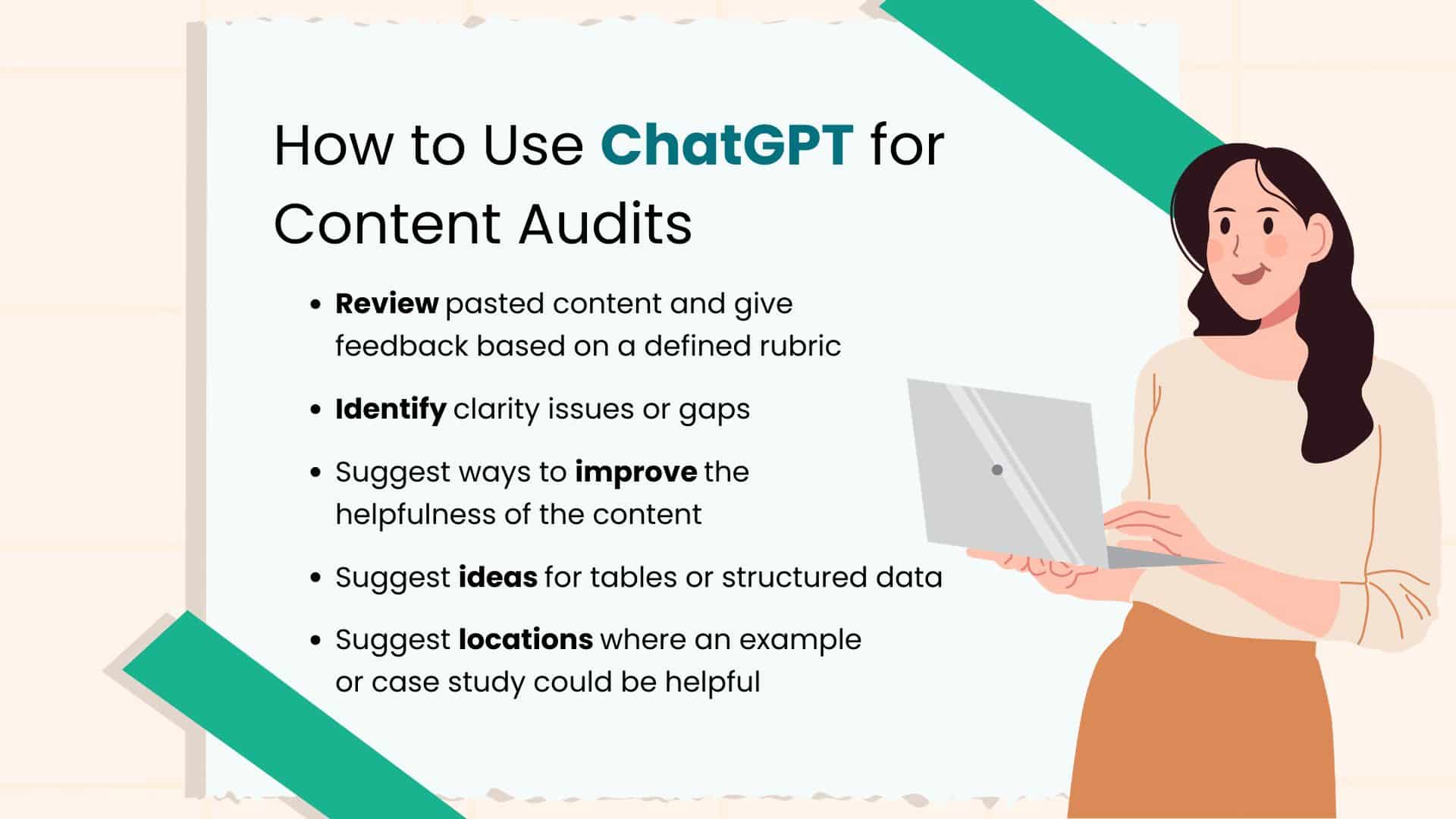
- Review pasted content and give feedback based on a defined rubric
- Identify clarity issues or gaps
- Suggest ways to improve the helpfulness of the content
- Suggest ideas for tables or structured data
- Suggest locations where an example or case study could be helpful
Training & Process Support
As is the case with many of these use cases, ChatGPT cannot train your team on its own.
But if you create prompts to assess your team’s work, it can provide feedback. However, you should never use this on its own. Models can change, and you simply cannot be sure that the feedback it’s giving is on point 100% of the time.
As of this writing, ChatGPT isn’t reliable enough to be a failproof trainer. You can, however, use it for the following training and process support tasks:
- Create content briefs based on a detailed prompt and writer input
- Help to produce standardized writing guidelines
- Assess content based on standardized writing guidelines
- Fact-check blog posts that are technical and get it to find sources to support claims (which then have to be checked by humans)
- Help junior writers improve drafts based on detailed and well-tested prompts
Data Interpretation (If You Provide the Data)
ChatGPT can be very good at reviewing large amounts of data and “seeing” patterns.
However, as mentioned previously, you have to provide strong prompts that specifically ask it to assess certain things.
You could use ChatGPT for the following if you include specific prompts:
- Summarize Google Search Console exports
- Identify patterns in queries or pages
- Suggest next steps based on performance

Here’s What ChatGPT Does NOT Do
We’ve talked a lot about how you can use ChatGPT to help you with your SEO.
And I know that I’ve warned you that it can be a real pain and cause frustration if not prompted well. It also acts more “knowledgeable” than it really is and can provide a lot of annoying warnings that are not legitimate.
At the end of the day, ChatGPT isn’t a source of wisdom.
It’s a tool that reads text and predicts what text should come next. It’s not exactly a genius at SEO. Here’s what ChatGPT cannot do:
- It can’t crawl your website
- It can’t replace SEO tools (Ahrefs, SEMrush, etc.)
- It can’t provide accurate keyword data
- It can’t build backlinks
- It can’t implement changes on your site
- It can’t really write “helpful” content with expert insights
- It can’t write like a human with idiosyncratic phrasing and word usage
- It can’t provide insights from its life experience
- It can’t build a solid SEO campaign based on real-world experience
- It can’t access the top SEO insights on the internet, as many are gated within closed communities and courses
- It can’t guarantee rankings
- And more…
There’s a lot that ChatGPT can’t do. So, in sum, ChatGPT can help you do SEO work if given sufficient high-level prompts from a human.
But, at the end of the day, you still need expert-level humans to design and execute your SEO strategy.
What Are the Pros and Cons of AI-Generated SEO Content?
There are just as many cons to AI-generated content as there are pros, particularly as Google is placing even more emphasis on the helpfulness and originality of content.
Since Google has its own AI overview, it doesn’t want you to just generate content that is completely devoid of human insights. In fact, the real differentiator between AI content and human content is the expert insights. Here are just a few pros and cons of AI-driven content:
| Pros of AI-Driven Content | Cons of AI-Driven Content |
| Fast to produce | Generic |
| Can be well structured | Doesn’t feel human |
| Clean grammar | Doesn’t contain expert insights |
| Can draw on a lot of information and generate robust articles that might have taken a writer a long time to write | May contain hallucinations, outdated, or incorrect information |
| Scales content production efficiently | It doesn’t actually “know” what will improve rankings |
Is Human Oversight Required for AI Content?
In a word: yes.
If you’re creating content for a high-stakes project, all content must be reviewed and punched up by an expert.
In addition, if you’re writing for a competitive niche, generic content won’t cut it. Your content must contain unique insights and case studies that allow it to be more authoritative and helpful than the generic stuff that ChatGPT produces on its own.
In addition, in high-trust or high-stakes projects, humans need to fact-check content that has been heavily driven by AI.
Tools like ChatGPT are not perfect replacements for human writers.
And as we become more accustomed to reading the relatively dry, soulless text of our AI tools, the creative and idiosyncratic element of real human writing becomes even more valuable.
In sum, you can’t outsource your writing to an AI agent if you’re working on a project that actually matters – like driving real humans to your website so you can convert them into clients.
Summary of Key Points
- ChatGPT can speed up SEO work, but requires strong prompts and detailed context or rubrics to perform well.
- ChatGPT works best for ideation, outlining, drafting, and editing, not strategy.
- ChatGPT cannot replace specialized SEO tools or expert implementation.
- ChatGPT often misleads users and can create ineffective or harmful strategies.
- ChatGPT doesn’t have the real-world experience needed to build successful SEO campaigns from scratch.
- AI works best in a hybrid model with expert input, not as a standalone content system.
- Without expert insights and human editing, AI content will not perform well.
- ChatGPT cannot access websites, implement changes, build backlinks, or provide accurate keyword data independently.
- If the goals of your SEO program are to increase revenue, there’s too much at stake to rely on an AI Agent.
To Bot, Or Not to Bot
So, the question becomes, should you use ChatGPT to power your SEO strategy? The obvious answer is…no.
Yes, you should use ChatGPT or another AI Agent like Claude or Gemini to help you speed up your SEO work, but you should not replace human experience, insights, and expertise with a piece of software that’s designed to identify patterns and then generate text based on what it “predicts” is the next best word.
AI agents built on LLMs are just predicting the best next words when they create a reponse.
They don’t have an actual “grasp” of SEO or how to rank content. They have no real knowledge.
So, for now, I recommend that you work with an SEO expert (or become one yourself) and use ChatGPT to speed up your content creation process.
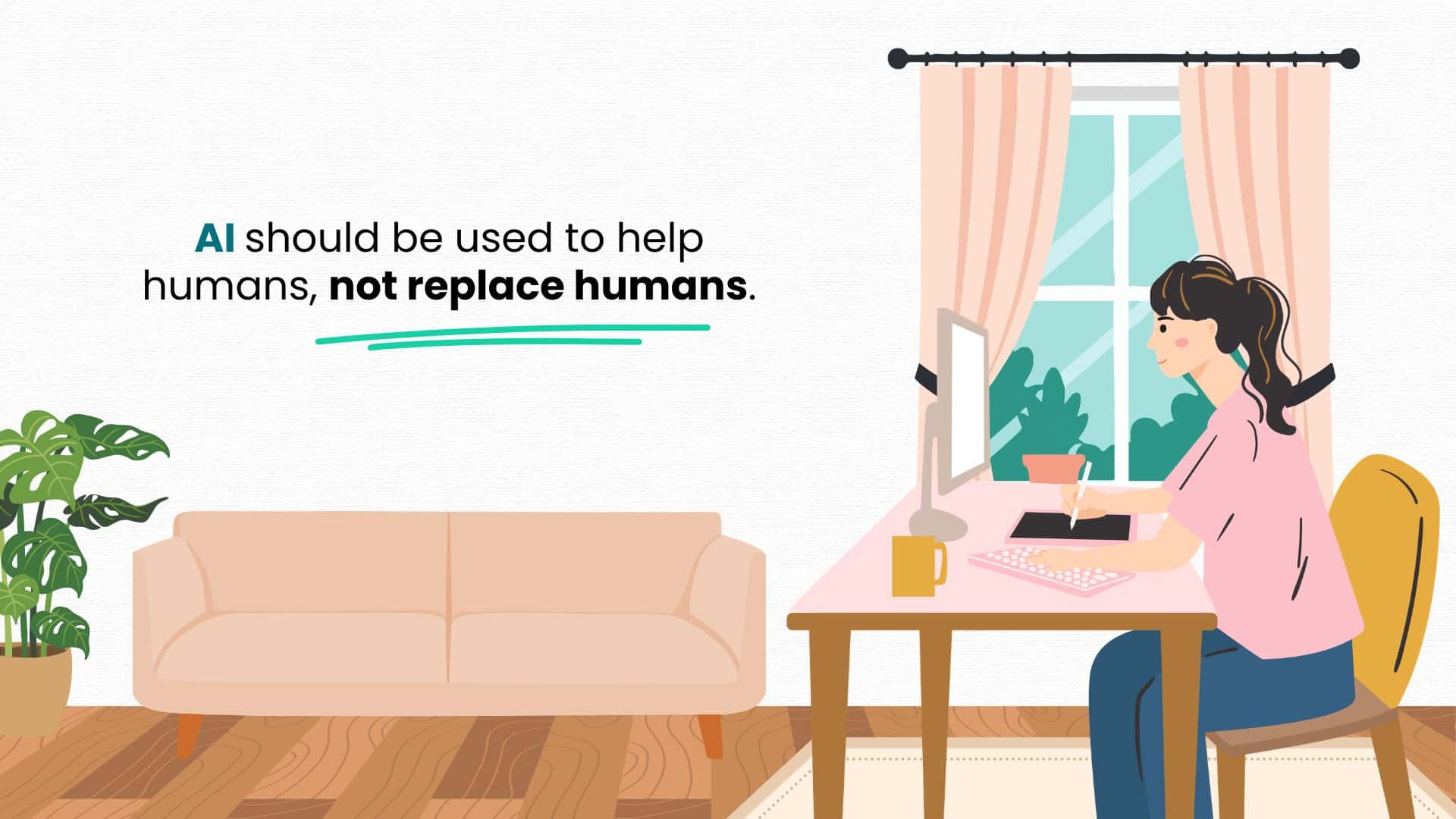
In general, it’s my opinion that AI should be used to help humans, not replace humans.
FAQ
What Is Generative Engine Optimization?
Generative Engine Optimization (GEO) is the process of increasing your business/website’s AI agent visibility through on-page and off-page strategies. AI Agents are generative engines that require data to produce results.
Your goal with GEO is to provide the necessary data that the AI agents need to predict that your brand should be included in a response.
Which AI tool is best for SEO?
I’ve used ChatGPT, Gemini, and Claude for creating content. Currently, I like ChatGPT best. But you have to set up customizations and give it strong prompts. Claude is also good.
Is SEO still worth it with AI?
Yes, SEO is still driving way more traffic than generative engines like ChatGPT. In fact, the amount of website traffic being driven by AI Agents is very small. Modern SEO includes optimizations that help you rank in Google’s AI Overview or be cited in AI mode.
However, it would be shortsighted to focus exclusively on increasing ChatGPT visibility while ignoring traditional SEO, which helps you get found on Google.
What is the 80/20 rule for SEO?
The 80/20 rule states that 20% of your content will produce 80% of your results. I’ve written an entire lengthy blog post on the matter, which you can read HERE.
How can I appear in ChatGPT with SEO?
Working to increase your visibility in ChatGPT is called GEO or Generative Engine Optimization. To increase your visibility in ChatGPT, you need to combine traditional on-page SEO with strong off-page authority signals that commingle your brand with the terms you’re aiming to get suggested for by ChatGPT.
For example, if you are a swimsuit brand that makes suits for curvy women, then you need your brand name to commingle with the phrase “swimsuits for curvy women” across the internet. The more times an AI agent sees a key term commingling with your brand name, the more likely it is to suggest your brand.
You can use traditional PR, guest posting, press releases, and “best of” lists to speed up this process. One easy way to get cited by AI Agents is to create a “best” list on your own website that cites you as the best brand for the thing you want to gain visibility for. I know that sounds crazy, but as of this writing, it works.
More Related Articles
⭐ Is SEO Worth It, or Is It a Scam?
⭐ How to Get Your Business at the Top of Google Search Results
⭐ What Is SEO? And How Does It Work?

About the Author
Hi! I’m Colette Nichol. I’m an SEO expert, story strategist, video producer, and digital marketer based out of rainy Vancouver, BC. I’ve been helping local expertise-driven businesses and global brands since 2014 when I founded Story Envelope Media.
In 2017, I started applying SEO to my work with clients and in my own business. The results were extraordinary, and I got obsessed!
If you’re interested in working together, please reach out. I’d love to hear about your business goals to see if my team and I can help.
We currently start just one new project per month and are typically booked out 3-months in advance.