

Is SEO Still Worth It for Advisors and Firms in 2026?
In a word: yes. SEO is still worth it for financial advisors in 2026.
In fact, SEO is more important than ever as marketing channels become more splintered and AI search begins to take off. SEO, also known as Search Engine Optimization, helps you get found on Google, Google Maps, Google AI Overviews, as well as surface in AI Agents like ChatGPT, Copilot, and Claude.
If you’re not doing SEO, then you’re not going to get found by AI Agents or on Google.
Google still drives the majority of website traffic. So, if you want to get found without running ads, then SEO is mission critical.
That said, if your firm isn’t located in a major city or hungry niche, SEO may not be as critical.
I recommend that you speak with an expert who understands both SEO and the financial services space.
Article by Colette Nichol, Story Strategist and Organic Growth Specialist

Table of Contents
- Why Does SEO Matter for Financial Advisors and Firms?
- What Is the Purpose of SEO for Financial Services?
- Who Can Benefit the Most from SEO?
- What Are the Biggest SEO Mistakes Financial Firms Should Avoid?
- What Exactly Is SEO for Financial Services?
- What Does SEO for Financial Services Include?
- How Can Financial Firms Use SEO to Attract More Clients?
- Summary of Key Points
- Final Thoughts
START Driving Traffic to Your Website: Speak with an SEO Consultant →
Why Does SEO Matter for Financial Advisors and Firms?
SEO is typically the largest untapped source of leads for financial services businesses.
If you’ve been growing your business with referrals, networking, events, walk-ins, ads, buying prospect lists, or M&A, then SEO likely has the potential to become your strongest source of leads and your highest ROI marketing channel. In particular, if you have a great sales system, then doing SEO is often a very wise decision. The better you are at closing qualified prospects, the more ROI you can get from your organic growth engine.
In general, financial firms should care about SEO because it has the potential to be their highest ROI marketing channel.
I recently calculated one client’s 2025 ROI based on the estimated lifetime value (LTV) of their newly acquired clients.
They added just over $76M in AUM to their book from organic sources.
Because that $76M will grow over time and some clients will withdraw while others will continue to invest, it’s impossible to be precise about LTV.
I use a simple yet conservative formula to calculate estimated LTV as year-one revenue x 10.
So, if the $76M in new AUM brings in $762k in year-one revenue, then I estimate the LTV of those new clients to be $7.62M. With an organic marketing spend of just over $100k in 2025, their lifetime ROI on that spend will be over 6,500%.
In reality, the LTV of their new clients may be much higher than that, since this firm’s clients are very sticky. They have a retention rate of 98%. So if the market continues to grow and they keep these clients for 30+ years, their LTV will be closer to $24M. If that’s the case, their ROI will eventually be a ridiculous 210x.
But back to basics. Just their year one ROI is 7x.
If you translate that into enterprise value calculated at 3x book, those new clients represent a 20x return. Many advisory firms buy books for 2x or 3x year-one revenue. With SEO, the numbers are reversed. Over time, your business is more profitable than if you were only acquiring clients through M&A.
Keep in mind that this is an example of a firm that I’ve been working with for many years.
You can’t expect numbers like that on day one. And every business’s ability to close deals is different. Every market is different. Not all firms can get numbers like this. But even a fraction of this client’s success still represents an excellent result and a high ROI marketing channel.
I know that if you’re new to SEO or have worked with an agency that isn’t super strong, these numbers may sound outlandish. I get it.
My client told me that he recently went to an advisor conference where the other advisors didn’t believe him when he said his firm has a client minimum of $2.5M.
They have a $2.5M minimum because they have more qualified prospects than they can handle. When the quantity and quality of prospects go up, and you don’t want to scale with volume, your minimum has to go up. It’s just part of filtering.
If you start to get found consistently on Google, then it’s not unreasonable to have a high minimum.
Think about it, SEO is the only organic growth channel that allows you to get found by people who are actually searching for you. While it’s never a bad idea to combine Google ads with SEO, ads alone are often not the solution for premium firms since the majority of searchers don’t click on ads.
In addition, by showing up organically, you build instant trust with prospects who see you as being “better” than everyone else since you earned their click by being visible at the top. In sum, showing up on the first page of Google allows you to get found by host prospects who are actually looking for your services and need help.
If those aren’t good enough reasons to care about SEO and building an organic growth engine, then I don’t know what is.

What Is the Purpose of SEO for Financial Services?
The purpose of SEO is to drive qualified traffic to a financial services website.
If you’re working with a growth expert, your SEO will also focus on converting a portion of your visitors into leads who can be qualified and converted to long-term clients.
Optimizing a website so that it can show up on the first page of Google doesn’t just mean tweaking a few things here and there. It often means overhauling the website architecture and creating a lot of new content that Google can rank.
Most financial services websites don’t have enough well-optimized service pages or blogs for Google to show the website.
If you have a five-page website and SEO has not been done, then it’s unlikely that your site will get surfaced by Google. In fact, being on page 2 means you’re basically invisible.
Whether you run a big firm or a small team, SEO is an excellent marketing channel for high-trust services like financial planning, wealth management, accounting, estate planning, and insurance.
Who Can Benefit the Most from SEO?
If you’re a firm with $150M or more in investable assets located in a major city or medium-sized yet affluent city, then SEO is a no-brainer.
Likewise, if you operate a niche wealth management firm that focuses on a very specific type of client, then SEO may be your next big growth lever. One of my top clients is a cross-border firm that uses SEO as its primary growth engine.
The key to a great niche is that your clients have a strong pain point, share similar concerns and problems, and are looking for guidance. Tech executives/professionals, business owners, doctors, and divorcees are all niche avatars. If you serve one specific niche, then SEO will work very well because you’ll quickly be able to build authority.
If you have multiple different “ideal clients” and are trying to communicate a broad service offering to many different audiences, it will be much more difficult to use SEO as a growth engine.
You typically see the fastest growth when you can be hyper-specific about who you serve.
This, however, is true across all marketing platforms. If you try to run Google ads or Meta ads with watered-down messaging to a broad audience, you’ll have a hard time getting ROI.
In sum, if you operate a $150M+ firm, you know exactly who you serve, and you’re focused on local or national clients, SEO is likely a very good fit. SEO opportunities exist within wealth management, estate planning, accounting, and insurance. So any financial services firm within these zones can achieve strong results.
What Are the Biggest SEO Mistakes Financial Firms Should Avoid?
The number-one SEO mistake financial firms make is not doing SEO.
This may sound tongue-in-cheek, but it’s true. Most small and even medium-sized firms don’t do SEO. Even more strange, I sometimes find firms that are writing articles, none of which are optimized for search. In other words, they’re producing content that will not get found by Google (or humans).
So the biggest mistake is ignoring SEO. But if that sounds like your firm, you’re in great company. According to a search study by Ahrefs, 96.55% of all pages in their index got no traffic from Google.
Most of the business owners who reach out to me have websites that get fewer than 100 visitors per month. This is bad.
If you’re not on the first page of Google for anything besides your brand name, then you’re not getting organic traffic. But that’s good news. Since you’re already making the biggest possible mistake, you can quickly remedy that.
Not Making Service Pages
Most financial services firms have a small handful of service pages.
When I look at financial advisor websites, I typically find 2-4 service pages. These pages are usually quite short and not optimized for Google or conversions. It’s almost as though these pages are an afterthought.
This is a huge mistake because good service pages can drive qualified traffic and prospects. They are often the highest converting pages despite having the lowest traffic. You should have a service page for every single aspect of your offering.
Targeting Broad High-Competition Keywords
If you try to gain traffic by making pages that are optimized for high-volume, high-competition keywords, then you’re bound to fail.
For example, let’s say you’re a wealth management firm in Quebec.
You create an English and a French page for Wealth Management. But you don’t do any geo-targeting. The page headline just says “Wealth Management” and doesn’t specify where.
These pages have a very low chance of success as they will be competing against very high authority websites (national $50B+ firms) who have created pages on this broad topic and are fighting for the top spot nationally.
Instead, you should have pages like “Wealth Management Montreal,” “Retirement Planning Montreal,” and “Investment Management Montreal.”
When you focus on making pages and posts that you can actually rank for, you win.
Inconsistent Content Publishing
One of the difficult things about financial services SEO is that you have to create a solid approvals pipeline.
There needs to be an efficient way to go from idea to content creation to compliance approvals to publishing. If compliance takes too long, it can slow down the process, resulting in inconsistent publishing and slower growth.
The key is to create a process up front, identify the types of things that will get major compliance pushback, and create a copywriting guide that includes what to avoid as well as what to include. When you have a brand voice document that covers all the major points about your business.
Having Too Many “Ideal” Client Avatars
If your firm is doing less than $10M per year in revenue but has 10 different ideal client avatars, this is slowing down growth.
Often, firms have a scattered approach to marketing that results in lower ROI.
From an SEO perspective, it’s best to focus first on one main avatar, gain traction, and then add another avatar.
What do I mean by that?
Let’s say that one of your ideal client avatars is a successful professional who is 5 years from retirement, lives in your city, has $2M+ in investable assets, and doesn’t have a retirement plan.
If you focus just on this avatar for six full months, you can build a very solid set of content pieces that are fully connected and create authority for your website and a conversion and traffic ecosystem. Each piece of content will be driven toward getting more of these exact types of people to your website and into your pipeline.
Now imagine that instead of focusing aggressively on their pre-retirement professional, you scatter your content across five different avatars.
You create content for business owners, retirees, executives, divorcees, adults getting an inheritance, etc. The content doesn’t tie together effectively or create authority for your website because it tries to cover so much ground.
Not Creating a Conversion-Optimized Website
Too often, I see websites that create massive friction for anyone who wants to take the next step.
People shouldn’t have to scroll for miles to find your call scheduler. They should be able to click and book a call easily. There is good friction and bad friction.
Good friction helps you qualify the people who are booking intro calls. Bad friction prevents even the most highly qualified prospects from booking a call in the first place.
The goal should be to get rid of as much bad friction from your website as possible.
Stopping Too Soon
SEO is empire-building. You’re building a castle and a moat that will serve you for many years.
At Story Envelope Media, we don’t offer SEO services to clients for less than 12 months.
Why not? Because it would be disingenuous. It’s not something you turn on and off. In fact, once you’ve built your foundation, it would be nuts to stop doing SEO.
SEO, just like all marketing, is something that you continue to do over the long term so that you can continue to get outstanding results.
However, it does take time to create that initial foundation and start to see results.
If someone “does SEO” for six months and then stops, they’re basically giving up right before they start winning big. We typically see strong results after about 8-12 months of work. Year 2 is when the compounding “magic” kicks in. But most firms don’t have a long-term view of marketing. That’s why SEO opportunities still abound for financial firms.

What Exactly Is SEO for Financial Services?
Having done SEO for financial services for over five years, while also working on other SEO projects, my glib answer to this question is that it’s just regular SEO, but much harder.
SEO stands for Search Engine Optimization, and it’s the act of optimizing a website so that it gets shown to searchers on Google.
If you do SEO properly, your ideal clients will find you on Google and convert to a call or email lead. You can then guide them through your sales process and convert the most qualified prospects into clients.
SEO is a growth marketing channel that allows you to grow your business with organic traffic.
While SEO also helps other search engines like Bing or DuckDuckGo surface your website, the majority of search traffic on the internet comes from Google. Thus, most SEO experts focus on Google.
What Does SEO for Financial Services Include?
SEO for financial services includes all the core components of Search Engine Optimization, but with a greater focus on accuracy, trustworthiness, and compliance-friendly content.
But to answer this question properly, we have to cover the basics.
SEO for financial services should include all of the following key components:
- Setting a goal for the SEO work
- Learning about the ideal client so that all content can be targeted toward them
- Doing keyword research for all segments of the buyer’s journey
- Creating high-commercial-intent service pages
- Creating supporting blog posts that also have the potential to convert to intro calls
- Creating content clusters with traditional pillar and supporting pages structures
- Doing traditional on-page, off-page, and technical SEO (more on this later)
- Focusing heavily on conversion optimization, particularly as it relates to intro calls
- Local SEO, including optimizing the Google Business Profile and local service pages
- Clear and on-target homepage optimized for search and for human conversions.
The list I just wrote covers the basics.
But if half of that list was Greek to you, don’t worry. It’s basically a list that says, “You need content on your website that is optimized for both Google and humans so you can get more people onto your website and nudge them into booking an intro call.”
Now, if your aim is to go upmarket and get more VHNW clients, then it’s also important to include one or all of the following in your marketing mix:
- Premium videos that educate and attract your ideal clients
- Branded photos that create an instant high-trust feeling on the website
- Clean, modern, sleek, and premium website that is responsive and works on all devices
- Low-friction call scheduler such as Calendly or iClosed
- Lead magnet that is very closely aligned with the fears/desires of your ideal clients
- A pop-up tool, such as OptinMonster, to promote the lead magnet
- Email marketing system and email nurture sequence to play the long game
These are the elements required for a true organic growth engine.
In the past five years, I’ve helped multiple financial services companies go from zero organic leads to 10, 20, even 30 calls per month. My clients regularly speak with prospects who have $10M+ in investable assets and have found them on Google.
I’ve helped these same clients add over $350 in AUM to their books.
So, I have experience working with financial firms, and I understand the struggle to get qualified prospects in the door.
I can assure you that SEO works. And it works just as well now as it did five years ago. People are searching for your services, and if you’re not showing up on Google, they’re simply clicking on your competitors’ links and taking their business elsewhere.
Now, let me break down some of the key elements that SEO for financial services include, so you know why these things matter.
Keyword Research
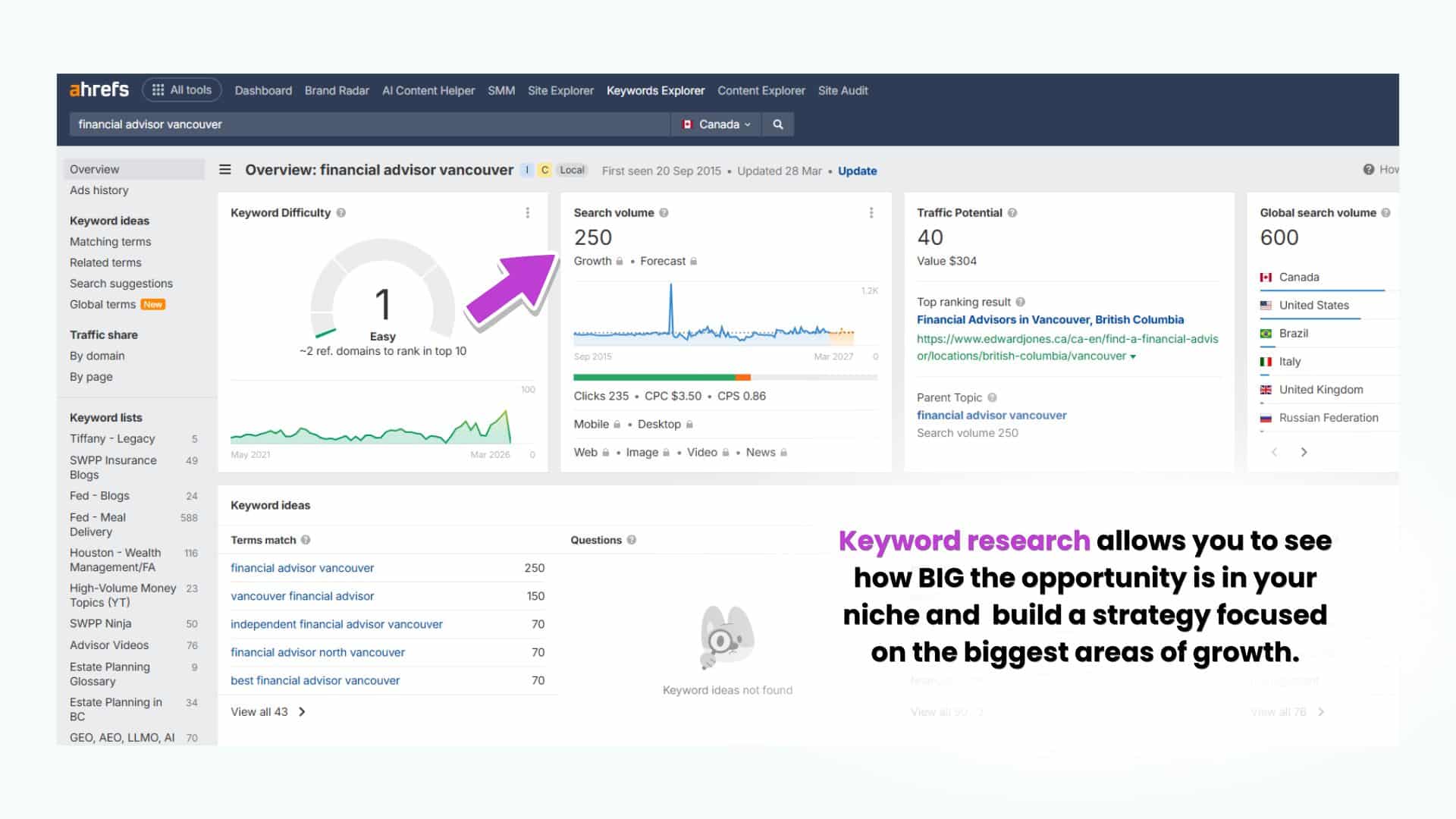
Keyword research is when you use tools like Ahrefs or SEMrush to do competitor research as well as gather the most relevant keywords for a particular business.
A keyword is actually a phrase, not a single word. So, for example, “wealth management firm Vancouver” is a keyword. Most financial services business owners and marketers don’t realize how vast the search landscape is.
In most major cities, there are thousands upon thousands of searches per month for financial services, ranging from wealth management to accounting, tax strategy, estate planning, and insurance. Keyword research allows you to see how big the opportunity is in your niche or area and then build a strategy focused on the biggest areas of growth.
Typically, a keyword research strategy includes finding the most important service page topics, pillar page topics, and supporting topics. The ultimate goal is to create a content blueprint that allows you to build traffic and authority that grows visibility and supports revenue growth.
Local SEO
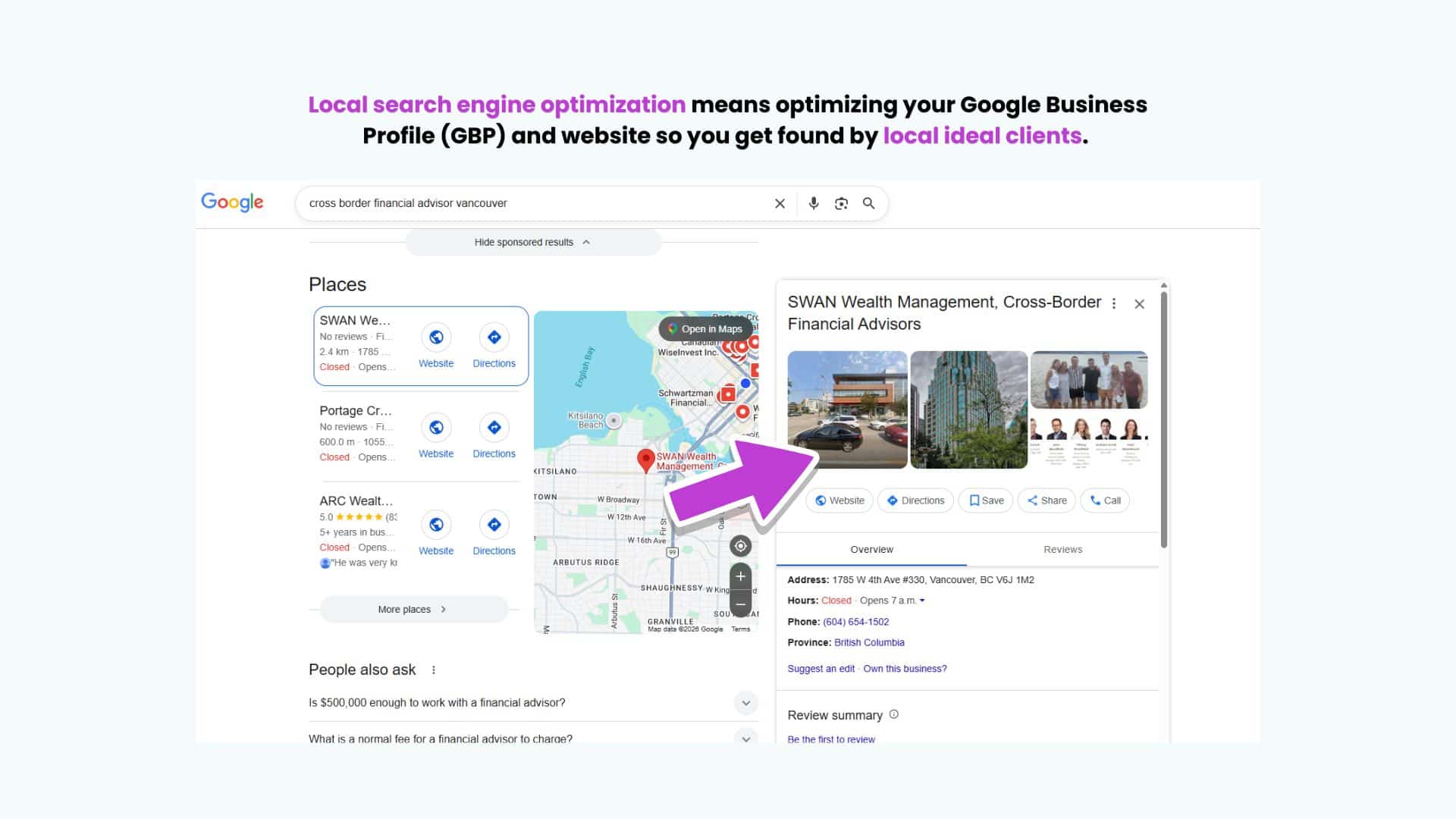
Local search engine optimization means optimizing your Google Business Profile (GBP) and website so you get found by local ideal clients.
The goal with the GBP is to help you show up in the local Google Maps Pack. While the goal of creating service pages and blogs is to show up on the first page of Google for both informational and high-buyer-intent searches.
The main way to optimize a website for local traffic is creating content including service pages, blog posts, and videos.
Local search is the same as traditional search, but with a local twist.
In other words, it’s “normal” SEO but with a heavy focus on getting you found in your city. Just like national or international SEO, you have to create service pages, pillar pages, and supporting blog posts in order to build authority and visibility.
There are some nuances if you’re trying to rank for a lot of different geographic areas. That’s where local SEO can get more complex.
On-Page SEO
On-page optimization refers to everything you do on the target website to help it surface more frequently on Google (and other search engines).
For example, creating new service pages based on keyword research would be considered on-page optimization. Enhancing your homepage, footer, nav bar, and site architecture is considered on-page SEO
Off-Page SEO
Off-page SEO basically comes down to getting backlinks.
The goal of most off-page SEO is to build authority for the target website by getting other high-authority and/or topically relevant websites to link back to the target. Google likes to pretend that its algorithms don’t pay attention to such things, but Google lies.
SEO experts constantly debate when and how you should go about getting backlinks. But as of this writing, most people agree that backlinks do help as long as the site and content you’re linking to are actually helpful and authoritative.
I’ve had quite a lot of success helping brick-and-mortar businesses get found with very minimal link building.
If your content is exceptional and you build additional authority with video, you don’t need as many links as a low-quality, low-authority site.
Service Page Development
Service page development is critical for financial services businesses.
Every iteration of the thing you sell should have a service page. For example, if you sell life insurance to doctors in Dallas, you should have a service page for that. If you do retirement planning in Dallas, you should have a service page for that.
Most financial services websites do not have enough service pages.
Service pages are based on high-commercial-intent keywords. People searching these keywords are very close to making a decision. The key is to create content for all stages of the buyer’s journey so that your ideal client just keeps finding you over and over again whenever they’re searching.
Compliance-Friendly Educational Blogs
Most non-marketers think that blogging is just something people did in the 2000s to share their feelings.
But I’ve seen blogs drive $10M+ prospects into my clients’ sales pipeline too many times to discount blogging. If you’re blogging in a way that is highly aligned with your ideal client’s problems and concerns, then with the right pivot text, you can turn readers into prospects.
I like to combine PAA campaigns with a pillar page strategy. PAA campaigns are based on common questions that people ask on Google. You can answer multiple questions about a similar topic and interlink them.
Meanwhile, a pillar page strategy involves creating one big mega post about a highly relevant topic and then building out all the supporting content that clusters around that pillar. You can refer to this as creating a content cluster with a strong pillar.
A solid pillar page strategy acts as a net for qualified prospects.
The purpose of both these strategies is to help your site gain authority, boost your money pages (the service pages), and also act as an additional lead generation engine.
Technical SEO
Technical SEO covers every single invisible aspect of SEO that helps your website get crawled properly, load quickly, and essentially communicate in a way that isn’t always obvious.
For fun, I’m going to give you a non-exhaustive list of technical SEO fixes and concerns:
- Improving the crawlability of the site
- Ensuring indexability of the site
- Configuring robots.txt
- Creating and optimizing XML sitemaps
- Structuring URLs and site architecture
- Optimizing internal linking
- Implementing canonical tags
- Setting up and fixing redirects
- Fixing broken links and crawl errors
- Resolving HTTP status code issues
- Improving site speed and performance
- Optimizing Core Web Vitals
- Ensuring mobile friendliness
- Implementing responsive design
- Securing the site with HTTPS
- Configuring SSL certificates
- Resolving duplicate content issues
- Implementing structured data and schema markup
- Handling JavaScript rendering issues
- Optimizing images
- Compressing and minifying files
- Setting up and optimizing CDN usage
- Handling infinite scroll correctly
- Managing site migrations and redirect mapping
- Choosing and configuring subdomains or subfolders
- Handling error pages like 404 and 500
- Improving accessibility where it impacts crawlability
If that list puts you to sleep, welcome to the club.
Here’s the truth: unless you have a very large website, these technical fixes are not usually the first order of business. Sometimes, major technical errors like a horrendous mobile experience must be dealt with right away. (Poor mobile will tank rankings.)
But often, it’s the design and content of your site that are the most critical elements to implement. Along the way, technical fixes can be implemented. These technical fixes on their own won’t drive traffic, but rather prevent your website from being penalized by Google and users.
Good SEO is about identifying the 20% that really moves the needle and focusing on that. (Not obsessing over tiny tweaks that will never provide legit ROI.)
For example, if your site has a poor user experience because it loads slowly and the navigation bar is awful, then your site will struggle to rank well even if your content is great. Likewise, if your site provides an outstanding user experience but has very little content, it won’t rank.
The goal of technical SEO is to create a foundation on which your excellent content can drive real growth.

How Can Financial Firms Use SEO to Attract More Clients?
If you’re a financial services firm in a major city or a medium-sized but highly affluent city, you should seek the guidance of a good SEO consultant or agency immediately.
There’s a lot at stake if you’re in an affluent or highly populous area.
There are literally thousands of searches per month by people seeking your services. SEO is complex and isn’t something that you can hand off to a junior marketer. It takes years to learn how to do SEO properly. Every day that you’re not doing SEO is another day that you’re handing hot prospects to your competitors.
That said, here are some key elements that move the needle when you’re doing SEO:
Optimize Your Homepage
Optimizing your homepage is often one of the first and most important steps.
Why’s that? Well, the homepage can typically rank for many of a business’s most important keywords. In addition, it’s critical to optimize your homepage for conversions and traffic. People who come to your website through a blog often end up jumping around to your homepage, about page, team page, and even process page.
Every main conversion points must be optimized to speak directly to your ideal client’s concerns and desires.
Optimize Core Service Pages
Most businesses simply do not have enough service pages.
It’s common to visit websites with just 2-3 service pages. This is not enough. You need a service page for every single thing that you help clients with. These pages need to be highly structured and focused on either your specific niche and/or your geographic area.
For example, if you own a wealth management firm, you should have service pages covering wealth management, investment management, estate planning, charitable giving, financial planning, executive financial planning, inheritance, tax strategy, retirement planning, and more.
Each service page allows you to get found for a specific genre of local search.
If you’re a niche advisory business that only focuses on helping a very specific type of client, then you need to break down your services as they relate to that client’s needs.
For example, retirement planning for doctors, investment management for doctors, estate planning for doctors, etc.
Publish Educational Blog Content
Creating educational blog content is absolutely critical to creating an organic growth engine.
Educational blogs build trust, get found by prospects who are mid-journey, earn backlinks, and build a website’s authority. The key is to be very specific about your ideal client and their problems, and only create content that is centred around one or two very specific ideal clients. The narrower you are in your focus, the better results you will get.
In addition, answering common client questions on the blog can be helpful from both a nurture and traffic perspective. You can use these blogs and their content to create nurture emails that grow your business long term.
Measure and Improve Performance
Tracking performance is key.
However, getting clean attribution data can be tricky. In other words, figuring out where your leads and closed deals are coming from can be difficult.
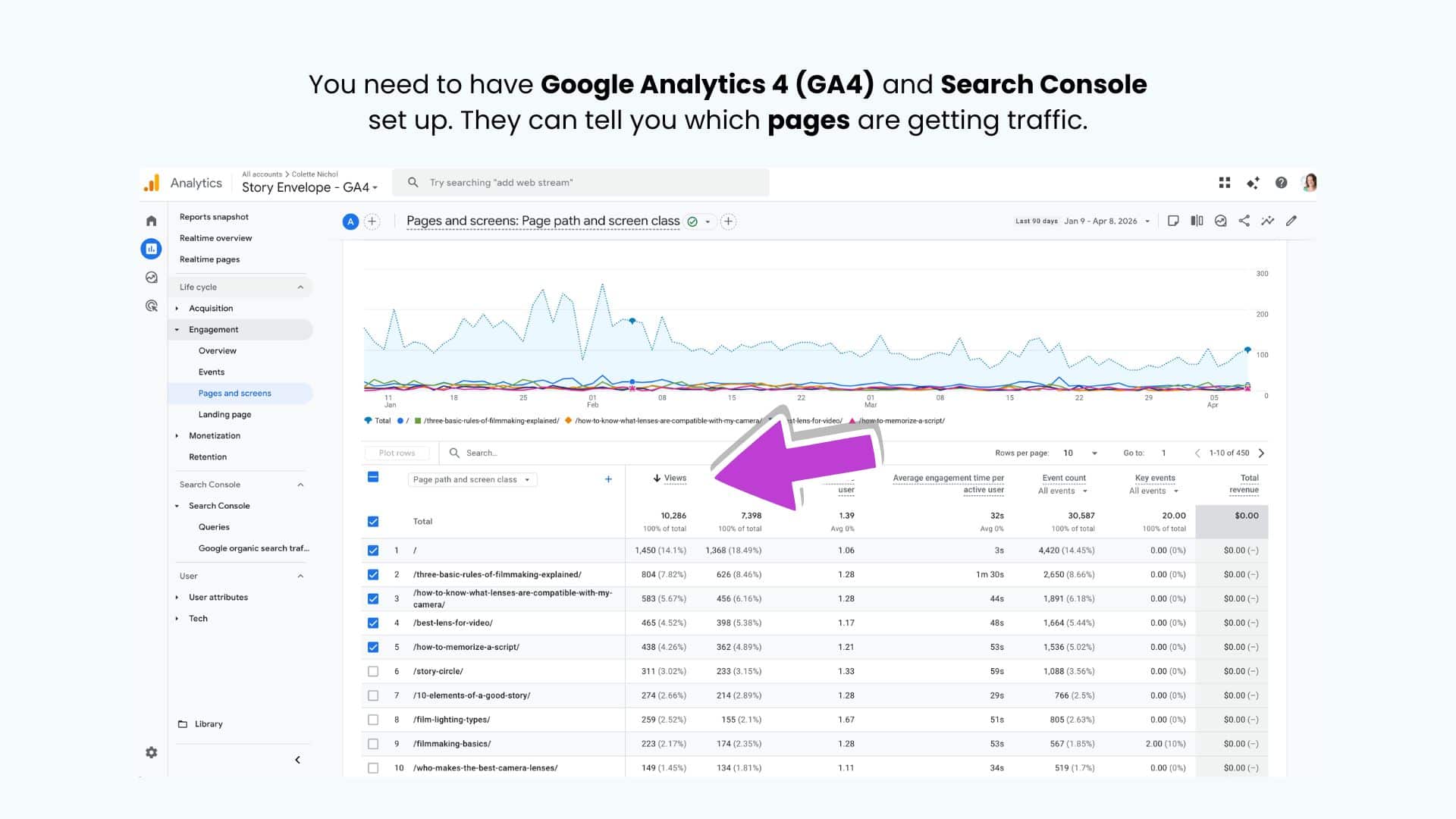
On a basic level, you need to have Google Analytics 4 (GA4) and Search Console set up. This can tell you which pages are getting traffic.
But, you also want to know which blog posts or service pages are resulting in booked intro calls.
You can use software like Hyros if you want the “perfect” tracking system. They are SOC II compliant and recommended by many ad and marketing experts.
Or you can set up UTM tracking with Calendly. With UTM tracking, you can send Calendly (call booking software) the information about the landing page, conversion page, and source of traffic.
Then you can review that data to identify your winning pages and content types.
Next, you aim to protect those pages by tracking performance and making more pages within the same wider theme. It’s important that you don’t make a whole bunch of pages that compete for the same key terms. This is called keyword cannibalization and can cause reduced performance.
Summary of Key Points
- SEO for financial services is designed to drive qualified leads, not just website traffic. The goal is to attract ideal clients and convert them into booked calls and long-term relationships. For this to work, your firm must have an excellent sales system.
- SEO for financial services requires higher standards of trust, accuracy, and compliance. Financial content must be precise, credible, and aligned with regulatory expectations to rank and convert.
- Ranking on Google requires sufficient content and proper structure. Financial websites need optimized service pages, blog content, and content clusters to gain visibility.
- Effective SEO targets every stage of the client journey. This includes high-intent service pages and educational content that guides prospects toward booking a call.
- A true organic growth engine combines SEO with conversion and trust assets. This includes strong website design, video, lead capture tools, and email nurturing systems.
Final Thoughts
The most important thing you can do today if you are the owner of a financial services firm is to schedule a call with an SEO expert to find out if SEO is the right move for your business.
If you’re in a major city and you’re not doing SEO, then you could be sitting on a very important source of highly qualified prospects. Right now, those prospects are all being delivered to your competitors.
Likewise, if you’re a niche firm with a very specific ideal client, SEO is an excellent marketing channel. The more specific your target audience, the more powerful SEO will be for your business.
More Related Articles
⭐ 200+ Financial Advisor SEO Keywords to Get Quality Leads and Traffic
⭐ How to Get More Clients as a Financial Advisor in 2026 (and Beyond)
⭐ SEO for Financial Advisors: How It Really Works in 2026

About the Author
Hi! I’m Colette Nichol. I’m an SEO expert, story strategist, video producer, and digital marketer based out of rainy Vancouver, BC. I’ve been helping local expertise-driven businesses and global brands since 2014 when I founded Story Envelope Media.
In 2017, I started applying SEO to my work with clients and in my own business. The results were extraordinary, and I got obsessed!
If you’re interested in working together, please reach out. I’d love to hear about your business goals to see if my team and I can help.
We currently start just one new project per month and are typically booked out 3-months in advance.