

What Does the 80/20 Rule Mean in SEO?
In SEO, the 80-20 rule refers to the generally accepted idea that 20% of your efforts generate 80% of your results.
This rule is based on the Pareto Principle, originally observed by Italian economist Vilfredo Pareto and later popularized by management consultant Joseph M. Juran.
History aside, how does this apply to your business and website? And is it really true?
On one of my client projects, the website has about 100 pages, yet 10 pages drive most of the booked calls. You could argue that 10% of the work has driven 90% of the booked calls on this project. However, that argument doesn’t take into account all the work done to build a website that allows us to get traffic in the first place.
While I agree that the 80-20 rule is likely “a thing,” it’s also important to note that you can’t ignore the many tasks required to build a foundation capable of driving traffic.
Nonetheless, the 80-20 rule is roughly true in the SEO world.
The good news is that it’s true for everyone.
A website needs a certain level of authority to command traffic. This means you can’t just make the 20% of important pages that you need to grow your business, and nothing else. In addition, in some cases, you may not be sure which pages will drive the most traffic and the best results.
You start with a goal and create content and an SEO plan focused on those goals.
Then you measure, assess, and do more of what works. Inevitably, many things do not work. But in the process of growing, building, and learning you create an organic growth machine that drives traffic and revenue.
Article by Colette Nichol, Story Strategist and Organic Growth Specialist
Table of Content
- Why Does the 80/20 Rule Matter for Your SEO Strategy?
- Which 20% Will Drive Most of Your SEO Results?
- How Does the 80-20 Rule Apply to Local SEO?
- How Can You Apply the 80/20 Rule to Improve Your SEO?
- Steps to Take to Stop Wasting So Much of Your SEO Budget
- Actions that Are Usually a Great Use of Time
- Mini Case Study
- Summary of Key Points: 80/20 Rule for SEO
Why Does the 80/20 Rule Matter for Your SEO Strategy?
If you know that 20% of your content will drive 80% of your results, you can be less precious and more speedy about deploying new pages.
In most cases, you’ll be assessing hundreds, even thousands of keywords and selecting a few to be turned into pages and posts. You may not know which will be the most valuable, but you do your best to assess.
Real growth comes when you begin to know your niche extremely well and can make much more informed decisions about content pieces.
For example, I’ve been doing SEO for financial advisors since 2020, so I am acutely aware of what drives things forward and what doesn’t. I can take this knowledge to save my client’s time and money.
The most important thing to know when you’re building traffic and an organic growth strategy is to focus on a very narrow and profitable niche. If you go too broad, it will be very hard to rank and gain valuable traffic. The narrower your niche, the more the 80-20 rule works in your favour.
START Driving Traffic to Your Website: Speak with an SEO Consultant →
Which 20% Will Drive Most of Your SEO Results?
To know what your highest-value 20% is, you need to be clear about your goals.
For the purpose of this post, I’ll assume that your goal is to increase revenue. This means you need to capture leads and make sales.
From an SEO perspective, this will happen on your website in most cases. However, your Google Business profile may also be an important piece of the puzzle. It may be a large part of the 20%.
To figure out which 20% of your SEO work matters the most, you need to know where your conversions are coming from.
There are only three types of conversions that matter on your website:
- Booked calls or appointments
- Email leads
- Sales
Depending on the type of business you run, you may have one or more of these types of conversions.
There is one caveat.
If you’re a brick-and-mortar business whose most important goal is to have customers visit your location, then the most important conversion point on your website may be the button that people click to go to your Visit Us page and then get directions. (I have one client where this is the case.)
How Does the 80-20 Rule Apply to Local SEO?
Next, if you’re a local business, then showing up on the Google Map Pack will be a very important part of your SEO work.
There are four types of conversions that matter on your Google Business Profile (GBP):
- Directions
- Call Clicks
- Visit Website
- Direct Booking Link Clicks (if you have one)
So, which of these conversions are the most important to you? Which is most likely to result in a sale?
Depending on your business, it may be just one conversion or all of them.
However, once you’ve fully optimized your GBP and maxed out all the traffic you can get from the Google map pack, you’ll need to turn your sights onto adding more service pages, which will get organic traffic.
In Local SEO, optimizing your GBP so you surface on the Google Map Pack, making persuasive service pages, and optimizing your homepage are the three most important things to focus on.
Yes, there are other things you need to do.
But these three things drive most of the results for most local businesses.
How Can You Apply the 80/20 Rule to Improve Your SEO?
First, make sure that you have set clear goals.
If you don’t know where you’re trying to go, then getting there with the 80-20 rule will be awfully hard. Your goals should not be about traffic alone. They must include sales and revenue numbers.
Based on your goal, you need to assess which key pages and posts are most likely to drive you more quickly toward those goals.
For example, let’s say you’re a blinds company that wants to sell more motorized blinds.
You already have quality service pages for your basic offerings. In the next two years, you want to increase revenue by 50% with a focus on motorized blinds since they are the highest ticket product.
Based on that goal, it’s simple to assess your website and decide on which pages and posts should be created. When you create a cluster of content based around a key topic such as motorized blinds, you’ll gain more traction more quickly than if you were to create a lot of broad content.
You could start by creating every possible long-tail service page catering to people who want motorized blinds in your area.
From there, you could create supporting blog content that answers common questions. You could build links to your blogs and service pages. And you could further optimize old pages or posts that are focused on motorization.
Finally, you could ensure that your pages are correctly interlinked so that you can squeeze the most juice from your existing content.
By focusing on a single product or service area for a campaign, you may be able to drive results more quickly.
Steps to Take to Stop Wasting So Much of Your SEO Budget
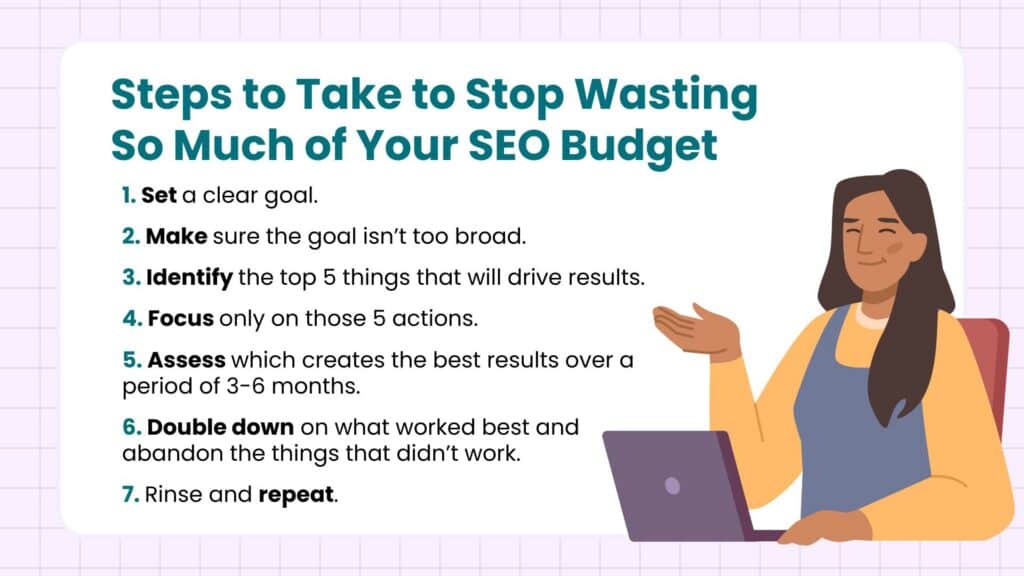
- Set a clear goal.
- Make sure the goal isn’t too broad.
- Identify the top 5 things that will drive results.
- Focus only on those 5 actions.
- Assess which creates the best results over a period of 3-6 months.
- Double down on what worked best and abandon the things that didn’t work.
- Rinse and repeat.
Actions that Are Usually a Great Use of Time
- Creating longtail service pages.
- Optimizing your homepage.
- Creating an outstanding homepage video focused on boosting conversions.
- Creating service page videos focused on driving conversions.
- Improving the conversion rate of your website and service pages.
- Write educational blog content that directly supports your most lucrative services or products and pivots people to take action.
- Creating big guides or pillar pages that are focused on topics that are critical to your clients. (For example, a guide to Estate Taxes and Inheritance in your region if you’re a financial advisor.) These guides can convert very well.
- Getting brand photos taken and implementing them on your websites. (These are great for conversion boosting.)
- Making sure it is dead easy to schedule a call with your team if you have a service business.
- Setting up conversion tracking of some kind.
- Making a great About page. (These pages get a lot of traffic and boost conversions.)
- Adding case studies to blogs, service pages, and a case study dashboard.
- Making your nav bar clean and easy to use.
- Acquiring backlinks that boost authority and help boost traffic.
- Optimizing already well-performing content.
- Improving internal linking to boost key money pages.
Mini Case Study
The most important thing to do if you want to maximize your results is to find a way to track performance so you can do more of what works and less of what doesn’t work.
One of my clients has 140 blog posts and a handful of service pages. I’ve found that about 10-15% of the content drives the majority of the introductory calls.
Their calls are driven by educational blog posts specifically targeted at the prospect’s biggest pain points. We’ve identified about 15 posts that drive most calls. But of those 15 posts, 5 drive the best calls.
You can see how narrow the success window is and why it’s so important to start tracking performance as best you can.
Summary of Key Points: 80/20 Rule for SEO
1. The 80/20 Rule in SEO: In SEO, the 80/20 rule (Pareto Principle) means that about 20% of your efforts generate 80% of your results. For most websites, a small portion of pages drives the majority of traffic and conversions.
2. Identify and Focus on High-Impact Activities: Success comes from knowing your goals and focusing on the pages and actions most likely to drive measurable business results, such as conversions and revenue, not just traffic.
3. Refine by Tracking and Doubling Down: Continuously measure which content and actions deliver the best outcomes, then double down on what works and eliminate what doesn’t. Performance tracking is essential.
4. Local SEO Priorities: For local businesses, optimizing Google Business Profiles (GBP), persuasive service pages, and the homepage are the top priorities. Most local SEO results come from getting these core assets right.
5. Niche and Quality Over Quantity: Targeting a narrow, profitable niche and creating high-quality, conversion-focused content is more effective than going broad. Supporting content, such as educational blogs and guides, along with strong internal linking and conversion tracking, amplifies results.
🤖This summary was made by a robot. However, the post was written by an expert-level human.
SEO & AI SEO Consultant
If you’re a business owner and want to work with an SEO consultant and expert, please schedule a 15-minute call with me.
The link to schedule the call is below. I work with local and global businesses that are in a growth cycle and want to increase their traffic. If you’re already spending money on advertising, but you’re not maximizing your online strategy with SEO, then you’re missing out on a major source of revenue.
There’s no better traffic than the people who are already looking to have their problems solved.
In most cases, SEO traffic beats all other forms of traffic and tends to have the highest ROI of all forms of online marketing.
SEO & Video Production Vancouver + Worldwide
Hi, I’m Colette Nichol! I’m a video producer, solo filmmaker, story strategist, and SEO expert based out of Vancouver.
Whether you’re based in Vancouver or the middle of the Arctic circle, I can help you get found online. As an SEO consultant and video producer, I typically work with clients who are experts in their field and want to reach a larger national or international audience and increase business revenue.
If you’re open to combining high-end evergreen videos with traditional on-page SEO and AI SEO, you can expect to see massive results. I’d love to hear about your business goals to see if working together might be a fit.
Get in touch HERE to schedule a 15-minute introductory call.
More Related Articles
⭐Increase Targeted Organic Traffic to Your Website with SEO
⭐Is SEO Worth It, or Is It a Scam?
⭐Quick Guide to SEO Marketing for Small Businesses

About the Author
Hi! I’m Colette Nichol. I’m an SEO expert, story strategist, video producer, and digital marketer based out of rainy Vancouver, BC. I’ve been helping local expertise-driven businesses and global brands since 2014 when I founded Story Envelope Media.
In 2017, I started applying SEO to my work with clients and in my own business. The results were extraordinary, and I got obsessed!
If you’re interested in working together, please reach out. I’d love to hear about your business goals to see if my team and I can help.
We currently start just one new project per month and are typically booked out 3-months in advance.