

What Are Financial Advisor SEO Keywords?
Article by Colette Nichol, Story Strategist and Organic Growth Specialist
Financial advisor SEO keywords are the specific search terms and phrases that potential clients type into search engines when seeking financial planning or investment management services online.
Financial advisor keywords serve as the foundation for search engine optimization strategies that help financial advisors rank higher in Google search results.
Using keywords effectively is critical if you want to attract prospective clients who are actively searching for financial guidance.
Unlike generic marketing approaches that focus solely on driving traffic or generating “awareness,” effective SEO for financial advisors prioritizes attracting qualified leads who are genuinely interested in working with a financial advisor or wealth management firm.

Summary of Key Points
- Local and niche keywords drive the most qualified leads.
- The most profitable keywords include service + city/state or service + niche audience. (Ex: financial planning in Dallas, retirement planning for doctors)
- Keyword research alone does not generate leads.
- Getting more traffic requires proper on-page SEO, conversion optimization, strategic content structure, and off-page SEO.
- Most advisory websites are not properly optimized.
- Short-tail keywords are a waste of resources for most small and medium firms.
- LLMs and Google reward structured and clear content.
- Service-page and homepage keywords provide the highest ROI.
- Blog content is necessary to rank service pages in competitive markets.
- Large publishers cannot cover niche or city-specific service pages, leaving major opportunities for local firms.
- Keyword difficulty, search volume, and search intent must be evaluated together.
- Professional SEO support is often necessary for meaningful results.
- Your SEO plan must include a conversion strategy.
- Off-page SEO and YouTube can dramatically accelerate results.
Table of Contents
- What This Guide Covers
- Keyword Research Isn’t Enough to Drive Leads
- What Are SEO Keywords for Financial Advisors?
- Types of Financial Advisor Keywords
- Keyword Difficulty and Search Volume
- Essential Financial Advisor Keyword Categories
- Common Keyword Challenges and Solutions
- Keyword Research and Selection Strategy
- When to Work with a Professional SEO Team
- Tips for Finding the Right SEO Team
- Final Thoughts and Next Steps
- Additional Resources
- Common Questions

Which Financial Advisor SEO Keywords Matter the Most?
When approaching SEO, it’s critical to realize that the most important keywords for your business depend on whether you’re focusing on your local area or a national niche audience.
For example, if you’re targeting doctors all across the United States, your keywords will be very different from a firm in Denver targeting high-net-worth individuals and business owners within Colorado.
Assuming that you’re a local advisor, the top keywords for your business will include the following:
- financial advisor + your city
- financial advisor + your state
- wealth management + your city
- wealth management + your state
- retirement planning + your state
- financial planner + your city
- financial planner + your state
- wealth advisor + your city
- wealth advisor + your state
In many cases, you’ll integrate some of these keywords into your homepage and aim to rank the homepage for many relevant local keywords. However, the strategy for ranking your website will depend on what’s working in your area.
If you’re focused on a national audience, you’ll need to research all the problems and solutions your target audience is searching for online and compile keywords that reflect their searches.
What This Guide Covers
This comprehensive guide covers how to pick the right keywords, what keywords actually are, as well as 257 example SEO keywords specifically selected for financial advisors, wealth managers, and financial planning firms. You’ll discover how to do keyword research and implement target keywords that generate quality leads rather than just website traffic.
Who This Is For
This guide is designed for financial advisors, registered investment advisors (RIAs), wealth managers, financial planning firms, and marketing directors for firms looking to attract more qualified leads. Whether you’re competing in local search results or targeting national markets, you’ll find actionable strategies for improving your search engine rankings.
If you’re interested in creating an organic growth engine for your firm, read our financial advisor case study in full to better undestand the process and the results you can get.
Why This Matters
A study by Chitka found that results at position #11 on Google (page 2) received only 1.11% of clicks. Meanwhile, position #1 received 34.35% of clicks. This study was done in 2013. So we can assume that behaviour has changed since then. However, if anything, people are likely scrolling less, not more.
If you’re not near the top of the first page of Google, either in the AI overview (AIO), the Google map, or within the first three positions of the traditional blue links, then you’re essentially invisible. With so much competition for searchers’ attention, targeting the right keywords is essential to client acquisition.
A large portion of potential clients begin their search for financial advisor services through Google searches, which means that ranking higher for relevant keywords directly impacts your ability to attract more clients and grow your practice.
What You’ll Learn:
- How to identify high-converting SEO keywords that attract qualified prospects
- Strategic approaches for choosing between high and low competition search terms
- Implementation techniques for target keywords across your web pages
- Methods for measuring and improving your financial advisor SEO efforts

START Driving Traffic to Your Website: Speak with an SEO Consultant →
Keyword Research Isn’t Enough to Drive Leads
Before we dig into the depths of keyword research for financial advisors, I need to be honest with you.
If you don’t know how to do SEO or optimize for conversions, then all the keyword research in the world won’t help you drive leads.
SEO isn’t just about stuffing keywords into website pages. SEO is about identifying the right keywords and integrating them strategically into your pages and posts so that Google and LLMs such as ChatGPT can identify what your posts and pages are about and show them to the right people.
Haphazard keyword integration doesn’t work.
After doing many website audits, I can tell you that most website owners do not know where to put their target keywords.
Your primary keyword must be placed in your H1 Heading, H2 Headings, Title Tag, meta description, intro paragraph, image alt tag, and final closing paragraph. If you’re writing a post, the keyword should also be found with a bulleted list near the top of the post.
I have a free website audit form on this website, and each month, business owners submit their websites to me for review. So far, I’ve never had a properly optimized website submitted.
Why not?
Because doing proper on-page SEO isn’t general knowledge.
If you plan to have an in-house marketer or assistant handle your SEO, I’d recommend hiring an SEO consultant to guide them so you don’t end up with a messy website that doesn’t drive any traffic.
Conversions aren’t automatic.
In addition, you need to optimize your pages and posts for conversions so that people don’t land on your website and click away. You need to have properly optimized call-to-actions (CTAs) placed correctly on all pages and posts.
I constantly see basic errors on websites. These fundamental errors will kill traffic potential and conversions. So if you’re a multi-advisor firm or a solo practitioner who is serious about generating leads with SEO, at a bare minimum, you should work with an SEO consultant to ensure your in-house content strategy is sound.
Off-page SEO is often required.
One final warning: content alone may not be enough to drive results. SEO agencies often integrate off-page SEO strategies into an SEO campaign. These strategies build authority and backlinks for your website and brand. When other websites link back to your site, it helps your site appear more authoritative and typically boosts traffic. It’s often a critical part of an SEO strategy.
In addition, if you’re genuinely motivated and want to dramatically boost results, creating a YouTube SEO strategy can help you with both off-page and on-page SEO as well as conversions.
Frankly, YouTube can be one of the strongest levers for growth if done correctly.

What Are SEO Keywords for Financial Advisors?
SEO keywords are the specific words and phrases that potential clients type into search engines when looking for financial planning services, investment advice, or wealth management solutions.
Search engines like Google use these keywords to match user queries with the most relevant financial advisor websites. When your web page content includes the right keywords and provides valuable information, search engine algorithms are more likely to display your site in organic search engine results for those terms.
Keyword targeting matters specifically for financial advisors because if you don’t target the right keywords, you won’t get found. You could have hundreds of pages on your website, but if they are not correctly targeted and structured, you will not generate leads.
Effective keyword research helps you identify the search terms your audience actually uses, rather than the industry jargon you might naturally prefer. On many occasions, I’ve had a client suggest a keyword they thought would be perfect, only for us to discover that no one is actually using it as a search term online.
Types of Financial Advisor Keywords
Short-tail keywords are broad, one- or two-word phrases like “financial advisor” or “wealth management” that have high search volume but also intense competition from established financial firms and large corporations. Essentially, going after short-tail keywords is impossible and pointless. Instead, you need to focus on long-tail keywords.
Long-tail keywords are more specific, multi-word phrases such as “fee-only financial advisor in Chicago” or “retirement planning for doctors.” Long-tail keywords capture user intent with greater precision. These keywords typically have lower search volume but higher conversion potential because they target users with specific needs. They are also attainable for local advisors who have a solid SEO strategy.
Local keywords incorporate geographic modifiers like “financial advisor near me” or “wealth manager in Denver” to attract clients in your service area. Local SEO is crucial for most advisory firms since many clients search in their local area. In addition, Google has a bias towards showing local results when people are searching for service providers. If someone in Denver types in “top financial advisors,” Google will primarily surface local results.
This connects to user intent because short-tail keywords often indicate informational searches, while long-tail and local keywords typically signal commercial intent from users ready to engage financial advisor services.
Keyword Difficulty and Search Volume
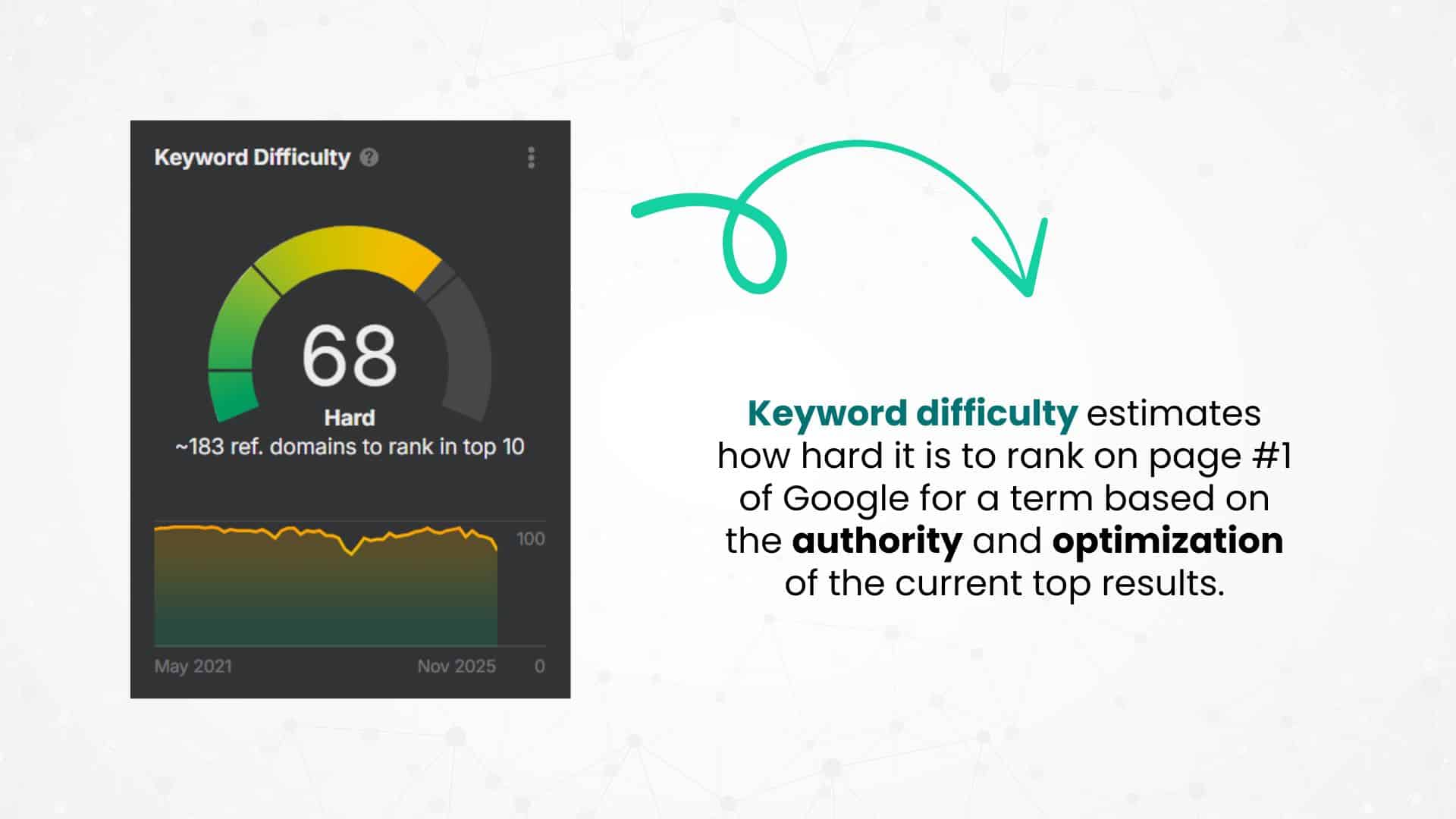
Keyword difficulty measures how challenging it will be to rank on the first page of search results for a specific term, taking into account the authority and optimization of currently ranking web pages.
Monthly search volume indicates how many people search for a particular keyword phrase each month, helping you estimate potential website traffic from ranking well for that term.
Generally, higher-search-volume keywords have higher difficulty levels because more websites compete for those valuable search terms. However, even achieving position 1-3 for lower search volume keywords with high commercial intent can have a very positive impact on lead generation, as these users are often closer to making a decision.
For example, “Denver investment advisor” only has 100 searches per month. However, ranking #1 on Google for this search term would be extremely valuable, as it is a specific, high-intent keyword.
Essential Financial Advisor Keyword Categories
Building on the keyword types discussed above, successful financial advisor SEO strategies target multiple keyword categories that align with different stages of the client acquisition process.
Service-Based Keywords
Service-based keywords target specific financial services, such as “retirement planning,” “investment management,” “estate planning,” “financial planning for doctors,” and “wealth management for athletes.”
To maximize effectiveness, match these keywords with your firm’s actual service offerings and get specific.
For example, if you specialize in retirement planning for federal employees, target “federal employee retirement planning” rather than generic “retirement planning” to attract more qualified prospects.
List out all the services you provide. Add a local area to that service or a specific avatar. Then plug these keywords into a tool like Ahrefs to see their search volume.
Formula: service you provide + local area
Example: financial planning Dallas
Local service keywords, such as the example above, combine your services with geographic modifiers, which help you appear in local search results. Unless you’re a major national firm, you should be focusing on local keywords and longtail service keywords.
Formula: service you provide + niche audience
Example: financial planning for doctors
Long-tail service keywords, such as the example above, are much easier to rank for nationally than seed keywords such as “financial planning.” In fact, unless you have $500k per year to spend on SEO, forget about ranking for broad keywords like “financial planning” or “retirement planning.”
You’ll be competing against national businesses with very deep pockets, and you won’t win. SEO is a numbers game. And the big companies can easily outspend small firms. Your best bet is to focus on niche, long-tail, and local service keywords, as big firms typically do not target them.
Problem-Solution Keywords
Problem-solution keywords address specific client pain points and questions, including phrases like “how to plan for retirement,” “best investment strategies for beginners,” or “what to do with 401k after job change.”
These are often question-based phrases with an informational search intent. They offer opportunities to create valuable blog posts and educational content that position your firm as a trusted authority. These types of keywords are also important when creating supporting content that helps you rank your website and service pages.
Unless you’re in a very low competition market, you typically need blog posts to support your service pages in order to rank. Informational, problem-solution keywords can be part of a pillar page strategy, content cluster, or silo. In other words, you can use these keywords to create structured groups of content on your website and drive traffic.
While problem-solution keywords are typically used to build authority, not drive conversions, I have seen some problem-solution blog posts convert into calls and then clients.
This approach aligns closely with content marketing and thought leadership strategies, as users who find helpful answers to their questions often become prospective clients when they’re ready to seek professional financial advice.
However, if you have limited resources, you need to stay narrow when doing problem-solution blogging.
For example, if you’re a local advisor, it may be best to focus on all the specific concerns that affect people in your state or city. Instead of writing a general blog post about 401(k)s, write a blog post about retirement planning strategies for business owners in Denver. Focus on your target audience and the city or state you’re targeting when doing problem-solution blogging.
Comparison Keywords
Comparison keywords capture users comparing different types of financial services, such as “fee-only vs commission-based advisor,” or “fiduciary financial advisor vs broker,” or “financial planner vs wealth advisor.”
Location-based competitive keywords like “best financial advisor in Denver” target users actively evaluating their options in your market area.
These keywords are particularly valuable because they capture users in the decision-making phase who are comparing alternatives and often ready to schedule consultations or request proposals. One difficulty with ranking for keywords such as “best financial advisor in Denver” is that you often have to write a list post comparing different firms. Many firm owners do not wish to have a list post like this on their website. However, from experience, I can tell you that these list posts perform very well on LLMs like ChatGPT and can be a lucrative addition to your SEO arsenal.
Key Points:
- Service keywords should match your actual offerings
- Problem-solution keywords build authority and capture early-stage prospects
- Competitor keywords target users ready to make decisions
With these keyword categories identified, the next step involves systematic research to find the specific terms your target audience uses most frequently.
Competitor Keywords
Competitor keywords are phrases that your competitors are ranking for on Google. They’re either targeting these keywords using paid ads or SEO. When you start an SEO campaign, you can do competitor research to see what your top competitors are ranking for and compare that to how you’re doing.
However, you never want to rely on competitor keywords. First, if all you do is copy your competitor’s strategy, you’ll have nothing unique to offer Google or searchers. Next, if your competitors are not very good at SEO, you’ll be copying a sub-optimal strategy.
In the financial services industry, I’ve found that the biggest competitors for advisory firms and wealth management firms are the large SEO-driven content companies such as Investopedia, NerdWallet, and SmartAsset. However, even these companies aren’t a huge threat since they don’t optimize for niche location keywords.
For example, Smart Asset has two prospecting blog posts to cover all of Minnesota. It has a blog post about the top financial advisors in Minnesota and another about the top financial advisors in Minneapolis.
- It doesn’t have a service page targeting high-net-worth executives or family offices in Minneapolis.
- It doesn’t have a page dedicated to financial planning in Minneapolis or Minnesota.
- It doesn’t have a page covering investment management for retirees in Minnesota.
- It also doesn’t have local pages for any of the affluent small towns close to Minneapolis.
In other words, it’s not doing Local SEO. It’s simply aiming to cover the big picture for all major cities and states.
Big SEO-driven companies like SmartAsset or NerdWallet focus on high-volume search traffic, not low-volume but highly relevant traffic.
In addition, these big competitors aren’t service providers, so they can’t make service pages. So while these websites do show up on the first page of Google for thousands of keywords, they don’t own the financial services search game. No matter how large they are, they can’t cover every topic.
Common Keyword Challenges and Solutions
Understanding typical obstacles in financial advisor SEO helps you avoid common pitfalls and implement more effective SEO strategies from the start.
Challenge 1: High Competition for Broad Terms
Solution: Focus on long-tail keywords and local variations to reduce competition while targeting users with specific needs.
Instead of competing for “retirement planning” against major financial firms with massive SEO budgets, target more specific phrases like “retirement planning for doctors” or “retirement planning for small business owners in Denver.” These pages will attract qualified prospects in your niche.
Challenge 2: Low Search Volume for Niche Services or Small Geographic Areas
Solution: Target multiple related long-tail keywords and create comprehensive content that addresses various aspects of your specialized services.
While individual niche keywords may have low search volume, combining several related terms in high-quality content can drive significant combined website traffic from highly qualified potential clients.
In addition, you should think outside the box. Research content ideas based on the problems people are searching for online that relate to your niche.
Keyword Research and Selection Strategy
Effective keyword research builds on the categories outlined above by using data-driven methods to identify the most valuable search terms for your specific advisory practice.
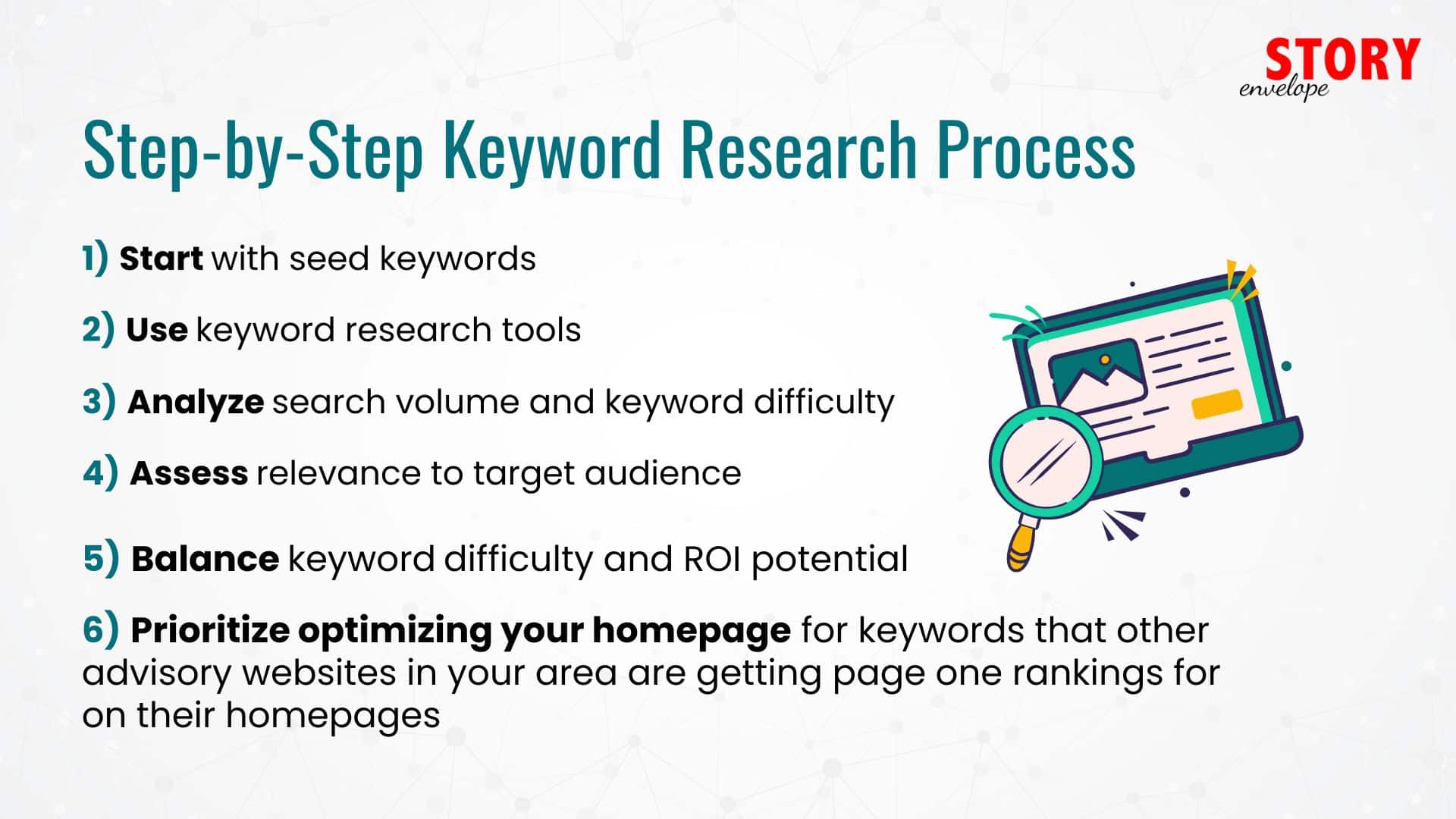
Step-by-Step Keyword Research Process
When to use this process: When creating your content plan for the year, before creating new content, optimizing existing web pages, or launching digital marketing campaigns.
- Start with seed keywords: Begin with 5-10 basic keywords related to your core financial advisory services, such as “financial advisor,” “retirement planning,” or “investment management.”
- Use keyword research tools: Expand your list using tools like Ahrefs, SEMrush, or Ubersuggest to discover related search terms and long-tail keywords your potential clients actually use. Focus on finding terms that include local-area keywords such as your state and city.
- Analyze search volume and keyword difficulty: Evaluate each keyword phrase for monthly search volume and competition levels to identify opportunities where you can realistically rank higher.
- Assess relevance to target audience: Ensure each keyword aligns with your services and the types of clients you want to attract, avoiding terms that might drive traffic but not qualified leads.
- Prioritize based on difficulty and ROI potential: Focus first on keywords with moderate difficulty but high commercial intent, then gradually target more competitive terms as your website’s traffic and authority improve.
- Prioritize optimizing your homepage for the keywords that other advisory websites in your area are getting page one rankings for on their homepage. Often, the homepage is the most important page in a local firm’s website.
Keyword Research & Content Creation Tools Comparison
| Tool | Cost | Search Volume Data | Competitor Analysis | Best For |
| Google Keyword Planner | Free | Accurate | Limited | Beginners and budget-conscious users |
| Ubersuggest | $58+/month | Good | Good | Budget-conscious users who want a simple interface |
| Ahrefs | $129+/month | Excellent | Comprehensive | Agencies and established firms with SEO budgets |
| SEMrush | $165+/month | Excellent | Comprehensive | Agencies and established firms with SEO budgets |
| Surfer (Keyword Research + Content Editing) | $79+/month | Pulls data from multiple sources; strong SERP analysis rather than raw volumes | Good (SERP-level competitor insights, content gaps, NLP entities) | Advisory firms and agencies that want an AI-assisted, SEO-optimized writing workflow |
| Page Optimizer Pro (POP) | $56+/month | Good (when using the silo planning tool) | Limited (compares your page to top competitors on SERPs) | Advisory firms and agencies are optimizing existing pages or creating new content silos |
| Keywords Everywhere (Chrome Plugin) | $140 for 400,000 credits per year | Good | NA | Advisory firms and agencies are analyzing SERPs and looking for long-tail and related keywords |
If you have ambitious growth goals, it’s essential that you have guidance when creating your SEO strategy. You should work with an SEO consultant or agency that has experience in SEO for financial advisors.
There’s too much at stake to be doing this alone and risk spending years on the wrong tasks.
An SEO consultant can create a strategy and train your in-house content team. They can also execute key parts of your SEO strategy for you. Meanwhile, a full-service SEO agency can create and execute a comprehensive SEO and content strategy in collaboration with your in-house experts and marketing team.
If you’re a smaller firm with 2-10 advisors, working with an SEO consultant or small SEO agency may be your best bet.
Smaller agencies and consultants typically provide more value for financial services firms that are not at an enterprise level.
When to Work with a Professional SEO Team
When you’re based in a large city, there’s substantial lead-generation potential in implementing local SEO properly.
Local searches can generate significant qualified traffic.
If you’re a firm with multiple advisors and a solid sales process, you should work with a good SEO team that can help you maximize both organic search engine results and conversion rates from website visitors to actual booked introductory calls.
There’s a lot at stake if you are located in a major city with strong SEO lead-generation potential. The revenue impact of ranking higher than competitors will more than justify the cost of professional SEO services. In my experience, SEO is one of the highest-ROI marketing strategies a firm can use.
I’ve seen well over 7000% ROI for some of my advisory firm clients.*
Tips for Finding the Right SEO Team
- Look for SEO providers with experience helping financial services companies who have an understanding of compliance requirements.
- Ask for case studies showing improved search rankings and lead generation for other financial advisors. Keep in mind that the exact details of any case study will be confidential, as most firms do not wish to have their data advertised online.
- Ensure the agency you work with is focused on driving qualified prospects and improving conversions, not just increasing website traffic.
Professional SEO services become more valuable as your practice grows and you have systems in place to convert increased web traffic into client relationships.

Final Thoughts and Next Steps
Strategic keyword targeting forms the foundation of successful SEO for financial advisors, enabling you to attract qualified prospects who are actively searching for financial advisory services rather than relying solely on referrals or traditional marketing methods.
To get started:
- Set up tracking in GA4 (Google Analytics) so that you can see which pages are driving conversions.
- Conduct keyword research for your top 3 financial advisory services using SEO tools such as Ahrefs or SEMrush.
- Do competitor research for the top 10 advisory firms ranking in your local area.
- Audit your existing website content for optimization opportunities on important web pages such as the homepage, service pages, and informational blog posts.
- Optimize your homepage and existing service pages based on your keyword research.
- Create new service pages based on any gaps you found when doing keyword research.
- Create a content calendar targeting priority keywords with monthly blog posts that address prospect questions and concerns.
- Ensure that your website and blog posts are optimized for conversions and not just traffic.
- Start a link-building campaign to add juice to your already excellent content strategy.
- Add video SEO into the mix so you can increase conversions and traffic.
If you don’t have a strong understanding of on-page SEO optimization techniques, local SEO strategies for Google Business Profile management, and content marketing approaches that support your keyword targeting efforts, you’ll need to do more research to create a plan.
Realistically, it takes years to become an expert at SEO.
If you’re serious about generating leads via SEO, you should hire a professional. Work with an SEO consultant or agency to create a solid SEO strategy that will help you grow your business.
Additional Resources
Free SEO tools every firm should be using:
- Google Search Console for tracking your current keyword rankings
- Google Analytics for measuring traffic from organic search engine results
Common Questions
Does SEO work for financial advisors?
Yes, SEO works exceptionally well for financial advisors. I’ve worked with wealth management firms that have added millions in AUM from organic traffic alone. SEO works best if you’re in a large or medium-sized city. But we’ve also had success doing SEO for a wealth management firm that’s in a smaller city but close to a major metropolis. If you’re a multi-advisor firm, you can do SEO for both your local area and your state or province.
What are the most profitable SEO keywords for financial advisors?
The most profitable SEO keywords for financial advisors are service-page keywords that have commercial intent.
In particular, the keywords that surface in homepage rankings are typically the most important keywords. For example, “financial planner Austen” would be an essential keyword for advisors and planners in Austen. However, it may be challenging to capture all the key service-page keywords if you don’t do any blogging to build authority. In addition, we’ve seen prospects convert on blogs as well as service pages. So while your service pages and homepage are the most critical pages, don’t ignore blogging.
What are the search engine results pages?
The search engine results pages or SERPs are pages that surface when you do searches on Google, Bing, DuckDuckGo, Yahoo and other search engines.
Some SEOs refer to the top results on the SERPs as the 10 blue links. However, the SERPs may also contain the following:
- Map Pack with Google Business Profile results
- Knowledge Panel with key information about the topic (right side)
- People Also Ask Questions
- People Also Search prompts
- AI Overview (AIO)
- Sponsored Ads
- Featured Snippets
- SERP Features, such as Weather or other tools
- Direct Answer Boxes
- Image Pack
- Videos
What is technical SEO, and do advisors need it?
Technical SEO is the optimization of a website’s technical elements to improve search visibility and traffic.
While some technical SEO updates may focus on improving the user experience, most aim to increase website traffic by removing technical barriers that currently reduce Google’s ability to crawl and rank website content.
You can purchase a technical SEO audit from some SEO providers and implement the changes yourself or with the help of a developer. In some cases, your website may be old or poorly built. If you haven’t invested heavily in your website and it’s more than 5 years old, you may be better off having a new, properly optimized website created for your business.

SEO & AI SEO Consultant
If you’re a business owner and want to work with an SEO consultant and expert, please schedule a 15-minute call with me.
The link to schedule the call is below. I work with local and global businesses that are in a growth cycle and want to increase their traffic. If you’re already spending money on advertising, but you’re not maximizing your online strategy with SEO, then you’re missing out on a major source of revenue.
There’s no better traffic than the people who are already looking to have their problems solved.
In most cases, SEO traffic beats all other forms of traffic and tends to have the highest ROI of all forms of online marketing.
SEO & Video Production Vancouver + Worldwide
Hi, I’m Colette Nichol! I’m a video producer, solo filmmaker, story strategist, and SEO expert based out of Vancouver.
Whether you’re based in Vancouver or the middle of the Arctic circle, I can help you get found online. As an SEO consultant and video producer, I typically work with clients who are experts in their field and want to reach a larger national or international audience and increase business revenue.
If you’re open to combining high-end evergreen videos with traditional on-page SEO and AI SEO, you can expect to see massive results. I’d love to hear about your business goals to see if working together might be a fit.
Get in touch HERE to schedule a 15-minute introductory call.
More Related Articles
⭐Increase Targeted Organic Traffic to Your Website with SEO
⭐Is SEO Worth It, or Is It a Scam?
⭐Quick Guide to SEO Marketing for Small Businesses

About the Author
Hi! I’m Colette Nichol. I’m an SEO expert, story strategist, video producer, and digital marketer based out of rainy Vancouver, BC. I’ve been helping local expertise-driven businesses and global brands since 2014 when I founded Story Envelope Media.
In 2017, I started applying SEO to my work with clients and in my own business. The results were extraordinary, and I got obsessed!
If you’re interested in working together, please reach out. I’d love to hear about your business goals to see if my team and I can help.
We currently start just one new project per month and are typically booked out 3-months in advance.
*The results that you get from your SEO campaign depend on the quality of your website, content, existing PR strategy and brand recognition, as well as factors such as your sales process and retention rate. This number does not guarantee that your company will achieve the same or similar results.